fintech IRELAND
email / social
  • Home
  • Fintech Authorisations
  • Fintech Education & Training
  • Fintech Ireland Map
    • Fintech Survey
  • Events
    • Summit
    • Events-Archive
  • Fintech Hub
  • News-Insights
    • Consultations
    • News Page Back Up
  • Careers
  • RegTech
  • CRYPTO
  • Fundraising
  • Brexit & Ireland
  • About
    • Fintech Family Network
  • Get Involved

More collaboration between Irish Banks and Fintechs to fight Financial Crime

5/7/2023

0 Comments

 
Picture
During the back half of May, Ireland was in the CFT/AML limelight with ACAMS Europe* and the European Anti-Financial Crime Summit both held in Dublin. This gave Ireland the opportunity to showcase the huge strides the nation is trying to make to combat financial crime. The key theme that I personally did not see come out as much as I’d like is the collaboration between Banks and FinTechs with Regulators and Enforcement agencies. 
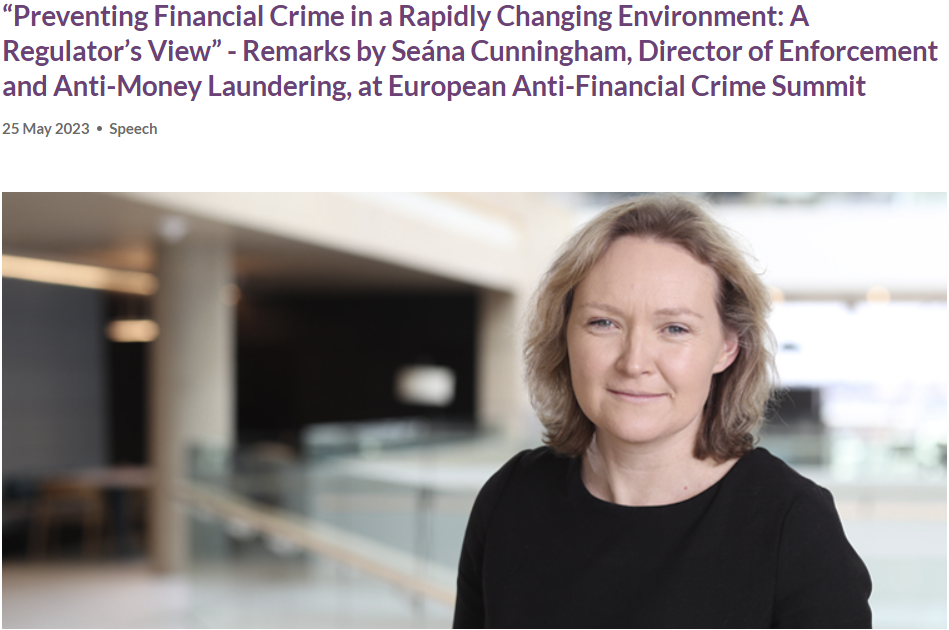
There were great keynotes from the likes of Seana Cunningham, Central Bank of Ireland’s Director of Enforcement and Anti-Money Laundering, who clearly illustrated the critical value in recognising shared goals and valuing collective effort; raising awareness and being vigilant; and understanding the changing risks. Additionally, given the much-anticipated launch of the EU Anti-Money Laundering Authority, irrespective of where they land the HQ*, clearly shows the global movement to more collaboration across states to fight financial crime. 
Picture
So, why not act locally within Ireland and drive more collaboration within the State as well?

Globally we are seeing some states like Hong Kong, UAE and the UK all announcing banks, enforcement and regulators combining forces to have a more collaborative approach to the joint battle. Ireland only having three (3) banks would suggest that more collaboration across these banks is a logical approach. While we can appreciate the restrictions of ‘over sharing’ due to GDPR restrictions, there must be an argument for sharing intelligence of high-risk economic crime activity across our society’s first line of defence in protecting the integrity of our financial system.

​The benefits of this collaborative approach to protect the risk of suspicious activity surely outweighs the paranoia.
​
But what about the FinTechs in Ireland? 
So, why not act locally within Ireland and drive more collaboration within the State as well?
​Ireland is well positioned as a breeding ground for FinTech’s and Payment Companies in Europe. In a recent piece written by IDA’s Chloe Wade, Ireland is continuing to scale and grow and there is a visible presence of sub-sectoral growth in Ireland in areas like digital payments, cross-border payments, payment gateways, digital banking, digital remittances, open banking, regtech, blockchain, and digital assets.

​International companies such as R3, Remitly, S&P Global, Revolut, MoneyCorp, and Boku have made Ireland the hub of their operations. These institutions are growingly coming under the watchful eyes of regulators due to the growth in bad actors using FinTechs and Payment Companies to channel illicit funds into the financial system. These companies should definitely have a more active role in the battle to combat financial crime activity. 
there is more responsibility that these high-growth institutions should adopt in protecting the integrity of the financial services system
Picture
How can the Banking and Payments Federation (BPFI) do more?

While BPFI have been instrumental in driving more collaboration, there are limitations given not all Banks and FinTech’s are actively involved in this joint effort. But it doesn’t stop there. In a recent article posted by Pearse Doherty, Deputy Leader (Dáil), Spokesperson on Finance and Public Expenditure and Reform, Pearse calls for more accountability for telecommunications and internet service providers and even social media. Usually when fraudulent activity occurs through these channels, the customer is already exposed, and the damage is done. This clearly shows that there is a need in Ireland for the wider cross-checking of account information which has proved to be successful in the Netherlands and Britain.

Conclusion

Ireland has become a global hub for FinTechs and Payment Companies alike and while this is fantastic for FDI and overall economic growth of the nation, there is more responsibility that these high-growth institutions should adopt in protecting the integrity of the financial services system. The  banks in Ireland, coupled with the FinTechs and Payment Companies, Regulators and Enforcement, can and will position Ireland as one of the safest countries to conduct transactions. Thus, setting the stage for further growth in a socially responsible and compliant manner.

The contents of this article are those of the author, Amardeep (Deep) Hansra, Global FinTech and RegTech professional.  Deep is on the Fintech Ireland Advisory Council.
​
END
​* Further Reading:
  • Fintech Ireland’s Founder Peter Oakes was a member of a cryptoasset panel at ACAMS Europe and also joined the ACAMS Great Crypto Debate on: The Future of Finance or Unleashing Havoc.
  • Fintech Ireland supports MoneyLaundering.ie which collates and publishes useful financial crime typologies  
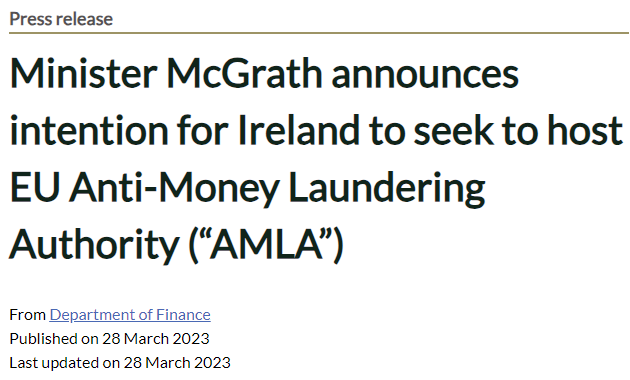
  • Minister McGrath announces intention for Ireland to seek to host EU Anti-Money Laundering Authority
  • Previous guest blog – Ireland’s VASPs holding their own against the UK? The Virtual Asset Service Providers Landscape in Ireland (co-authored by Susan O’Neill of SuLu Solutions and Peter Oakes of Fintech Ireland)
0 Comments

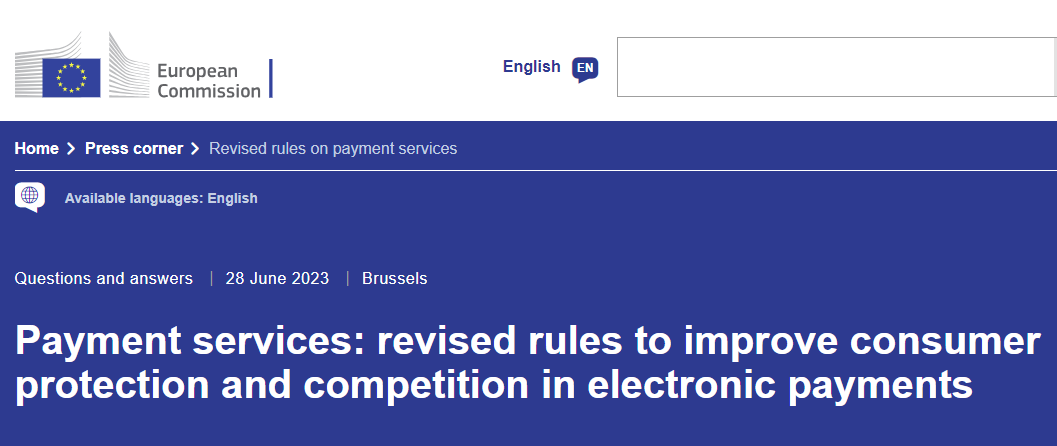
PSD3: The European Commission to revise rules  to improve consumer protection and competition in electronic payments

28/6/2023

0 Comments

 
Picture
These amendments, in the view of the European Commission, represent an evolution not a revolution of the EU payments framework. The amendments are aimed at improving the functioning of EU payment markets by:
​
  • strengthening measures to combat payment fraud;
  • allowing non-bank payment service providers (PSPs) access to all EU payment systems, with appropriate safeguards, and giving them a right to have a bank account;
  • improving the functioning of open banking, especially as regards the performance of data interfaces, removing obstacles to open banking services and consumer control over their data access permissions;
  • reinforcing the enforcement powers of national competent authorities and facilitating implementation of the rules clarifying various elements;
  • further improving consumer information and rights;
  • improving the availability of cash; and
  • merging the legal frameworks applicable to electronic money and to payment services.

Further reading:
  • Download Revised Rules on Payment Services 
  • Press release
  • Factsheet
  • Legal texts
0 Comments

Central Bank of Ireland Safeguarding Notice, 25 May 2023

31/5/2023

0 Comments

 
Picture
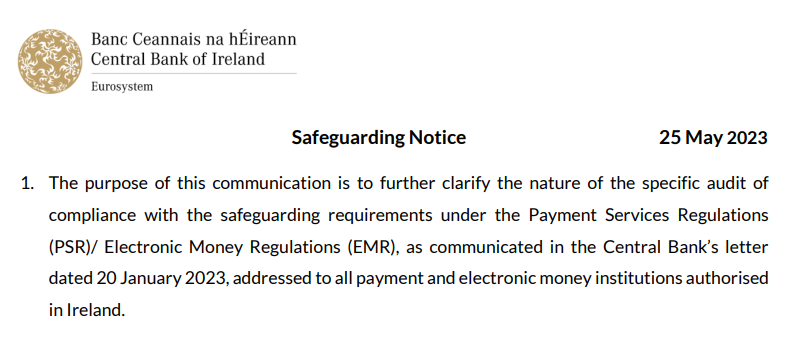
Safeguarding Notice 25 May 2023
 The purpose of this communication is to further clarify the nature of the specific audit of compliance with the safeguarding requirements under the Payment Services Regulations (PSR)/ Electronic Money Regulations (EMR), as communicated in the Central Bank’s letter dated 20 January 2023, addressed to all payment and electronic money institutions authorised in Ireland.

Following discussions with Chartered Accountants Ireland (CAI), an acceptable format for these engagements has been agreed, as detailed below. CAI will issue guidance to their members on performing these engagements in due course. 

Click here for the (1) 25 May 2023 Safeguarding Notice; and (2) ​20 January 2023 CBI Dear CEO Letter.
0 Comments

Eouncil adopts new rules on markets in crypto-assets (MiCA)

16/5/2023

0 Comments

 
Picture
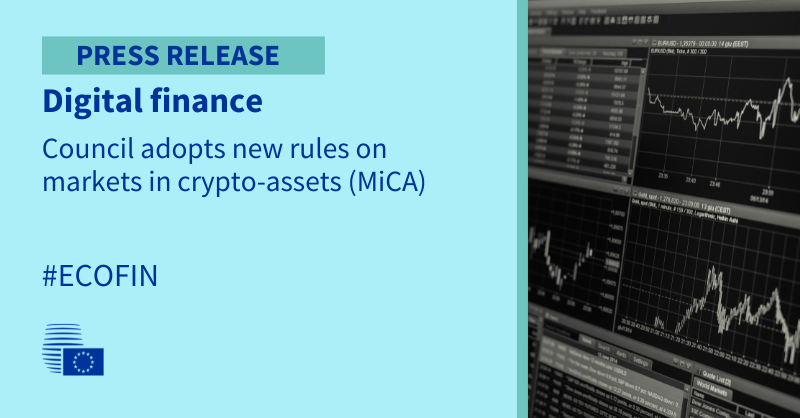
​16 May 2023 Brussels: The EU brings crypto-assets, crypto-assets issuers and crypto-asset service providers under a regulatory framework. Setting an EU level legal framework for this sector for the first time, the Council today adopted a regulation on markets in crypto-assets (MiCA).
Picture
​I am very pleased that today we are delivering on our promise to start regulating the crypto-assets sector. Recent events have confirmed the urgent need for imposing rules which will better protect Europeans who have invested in these assets, and prevent the misuse of crypto industry for the purposes of money laundering and financing of terrorism.
Elisabeth Svantesson, Minister for Finance of Sweden
​MiCA will protect investors by increasing transparency and putting in place a comprehensive framework for issuers and service providers including compliance with the anti-money laundering rules. The new rules cover issuers of utility tokens, asset referenced tokens and so-called ‘stablecoins’. It also covers service providers such as trading venues and the wallets where crypto-assets are held. This regulatory framework aims to protect investors, preserve financial stability, while allowing innovation and fostering the attractiveness of the crypto-asset sector.

It also introduces a harmonized regulatory framework in the European Union which, given the global nature of crypto markets, is an improvement compared to the current situation with national legislation in some member states only.

Background 

The European Commission presented the MiCA proposal on 24 September 2020. It is part of the larger digital finance package, which aims to develop a European approach that fosters technological development and ensures financial stability and consumer protection. In addition to the MiCA proposal, the package contains a digital finance strategy, a Digital Operational Resilience Act (DORA), that covers crypto-asset service providers as well, and a proposal on distributed ledger technology (DLT) pilot regime for wholesale uses.

This package bridges a gap in existing EU legislation by ensuring that the current legal framework does not pose obstacles to the use of new digital financial instruments and, at the same time, ensures that such new technologies and products fall within the scope of financial regulation and operational risk management arrangements of firms active in the EU. Thus, the package aims to support innovation and the uptake of new financial technologies while providing for an appropriate level of consumer and investor protection.
The Council adopted its negotiating mandate on MiCA on 24 November 2021. Trilogues between the co-legislators started on 31 March 2022 and ended in a provisional agreement reached on 30 June 2022. Today’s formal adoption of the regulation is the final step in the legislative process.

Links

  • Regulation on markets in crypto-assets (MiCA)
  • Digital finance: agreement reached on European crypto-assets regulation (MiCA) (press release, 30 June 2022)
  • Digital finance (background information)
  • Visit the meeting page
0 Comments

Ireland’s VASPs holding their own against the UK? The Virtual Asset Service Providers Landscape in Ireland

12/4/2023

0 Comments

 
Picture
This article is co-authored by Susan O’Neill of SuLu Solutions and Peter Oakes of Fintech Ireland*.

17 July 2023 - find New Version of this Registered Virtual Asset Service Providers Map, V 2.0 HERE

[Updated on 12 April 2023 to add Kraken to the article which appear on the VASP register today]


Ireland has a small number of registered Virtual Asset Service Providers (VASPs). In Ireland it is a criminal offence to carry on the business of a VASP in the absence of registration from the Central Bank of Ireland (CBI). VASPs came within the scope of Ireland’s Anti-Money Laundering (AML)/Countering Financing of Terrorism (CFT) legislation in April 2021.  As per the CBI Anti-Money Laundering Bulletin issued on 8 July 2022 (CBI AML Bulletin), “In the intervening period, a significant number of firms have applied to the Central Bank for registration.”

If a significant number of firms have applied to be registered as VASPs – the question arises as to: “Why, 2 years later, Ireland has issued only six (6) VASPs?” This begs further questions: Is Ireland behind the curve compared to its international peers? Are the firms applying in Ireland sufficiently resourced to become VASPs? How do we, more specifically, compare to our neighbours in the UK?
​
If a significant number of firms have applied to be registered as VASPs – the question arises as to: “Why, 2 years later, Ireland has issued only six (6) VASPs?”
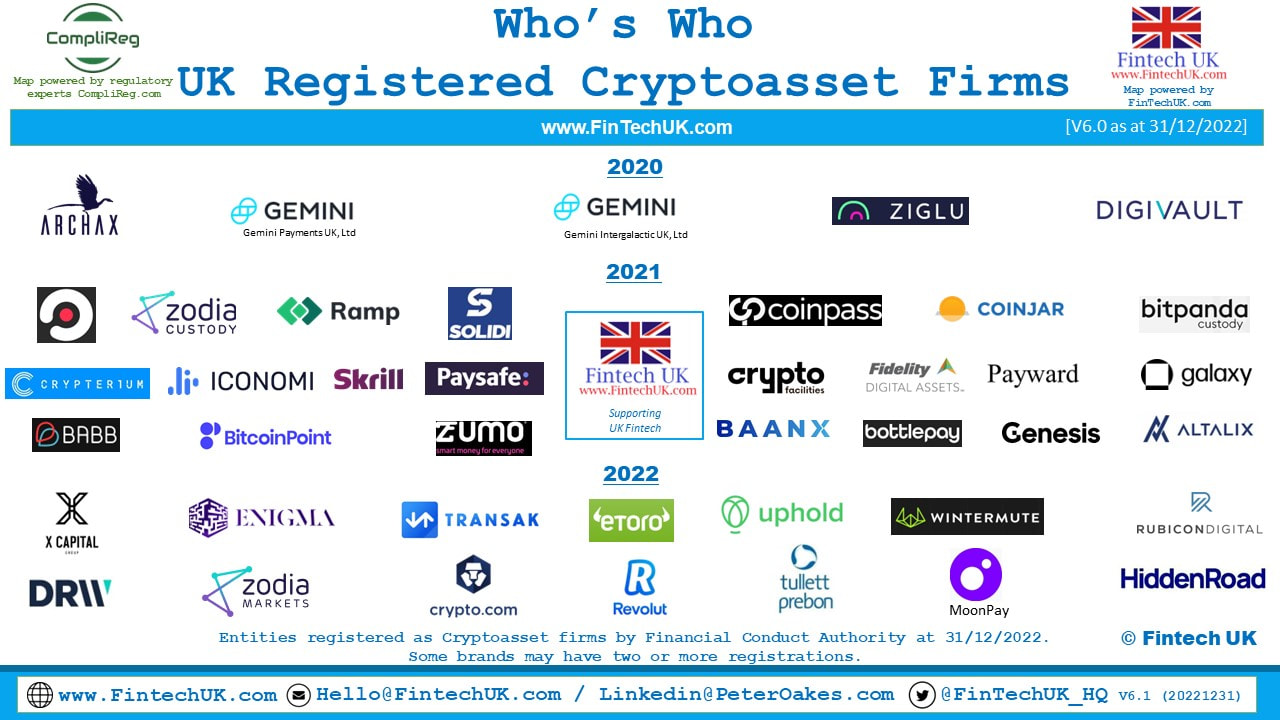
​Of the six (6) registered VASPs –two of the registrations are held by Coinbase. The UK has 41 cryptoasset firms registered with the Financial Conduct Authority (FCA). The FCA also have a list of 82 unregistered cryptoasset businesses (as at 31 March 2023), down from close to 250 during 2022, but perhaps this is a topic that deserves an article all of its own!

The UK has 41 cryptoasset firms registered with the Financial Conduct Authority
Picture
Check out Fintech UK's most recent edition of its famous UK Registered Cryptoasset Firms Map
The UK’s population is 13 times larger than that of Ireland (UK 67.33mn versus Ireland 5.033mn according to World Bank, Eurostat 2021 figures). Accordingly, the UK has one registered cryptoasset firm for every 1.64mn persons.  Whereas for Ireland it is one crypto firm for every 838,833 persons.  By that comparison, Ireland has more crypto firms per head of population than the UK. Based on those numbers Ireland is not only holding its own vis-à-vis the UK, it is exceeding it by a large margin.  If Ireland registered say another 9 VASPs (to get it to 15 VASPs) it would have one cryptoasset firm for every 335,500 persons. Is this something that policymakers, the government and the CBI take into account as part of their respective cryptoasset strategies? 
Ireland is not only holding its own vis-à-vis the UK, it is exceeding it by a large margin.
The CBI AML Bulletin noted the following “In its assessments of applications for registration as a VASP, the Central Bank has identified significant and widespread weaknesses in the proposed risk and control frameworks of the vast majority of applicants. These weaknesses are such that the Central Bank is not satisfied that firms will have the necessary and appropriate controls in place to effectively manage and mitigate the ML/TF risk to the firm, the sector and society.”


Widespread weaknesses in “the vast majority of applicants” does not inspire confidence in the future of VASP applicants in Ireland. However, it is relevant to note that the FCA too has, as recently as 22 March 2023, criticised the quality of cryptoasset applications received by it, particular in areas relating to business plans, comprehensive description of products and services, risk assessment, risk management, policies, systems & controls, Transaction monitoring and blockchain analysis coverage, Group structure and reliance on group policies and procedures, Outsourcing, Training, Suspicious Activity Reporting and regulatory disclosures.  The FCA reminded crypto asset firms of its concerns on 5 April 2023 (see below).

​So, what can be done to support applicants, and thereby improve applications? There is no doubt that the crypto industry is going through the growing pains of a market that needs regulation, but regulation needs to put the guard rails in place to support its users, while also ensuring it does not stifle innovation. There is a very real opportunity here to ensure that Ireland is at the forefront of positive regulatory changes – Ireland could become a hub for the crypto ecosystem.  There are already a number of very large players based in Dublin.  In the same breath, the cryptoasset firms and VASPs referred to in this article are themselves not ‘regulated’ but are merely registered for the purposes of anti-money laundering and terrorist financing laws, i.e. VASPs and cryptoasset firms in Ireland and the UK are not authorised.  However some such firms have a separate authorisation, for example Archax, which is both a registered cryptoasset firm and a UK authorised investment services firm and multi-lateral trading facility, subject to extensive conduct and prudential rule books.  As the crypto industry continues to mature, expect to see numerous ‘digital asset’ firms seek to differentiate and distance themselves from the speculative trading and exchange-driven cryptoasset firms which are falling under evermore regulatory scrutiny such as Binance, Coinbase and Kraken and the failed FTX and Genesis Trading (both of which have filed for bankruptcy protection in the US).
​
There is no doubt that the crypto industry is going through the growing pains of a market that needs regulation, but regulation needs to put the guard rails in place to support its users
​In order to address some of the concerns noted above, the European Union’s trailblazing Markets in Crypto-Assets (MiCA) Regulation is set to come into effect across all member states in 2024, but will it be enough? Dubai’s Virtual Asset Regulatory Authority is the world’s first independent regulator for virtual assets.  Dubai is fast becoming a hub for the crypto ecosystem. Could Ireland benefit from a similar initiative? This is highly unlikely as Ireland traditionally follows the EU’s lead on new financial services regulations and there has been nothing issued by the Department of Finance to suggest that this time is different.  In April 2022 the UK Government announced its plans to make the UK “a global cryptoasset technology hub”. The UK government intends to bring stablecoins into the regulatory perimeter and has launched a consultation on the country’s proposed central bank digital currency or ‘digital pound’ as it is called.  The UK also caught many in the industry unawares when on 31 January 2023, without warning, it published a consultation on the Future financial services regulatory regime for cryptoassets.
​

Who are the Super Six of Irish Crypto?
​

​So, who are the companies that have managed to obtain the elusive Irish VASP registration and what services are they registered to provide?
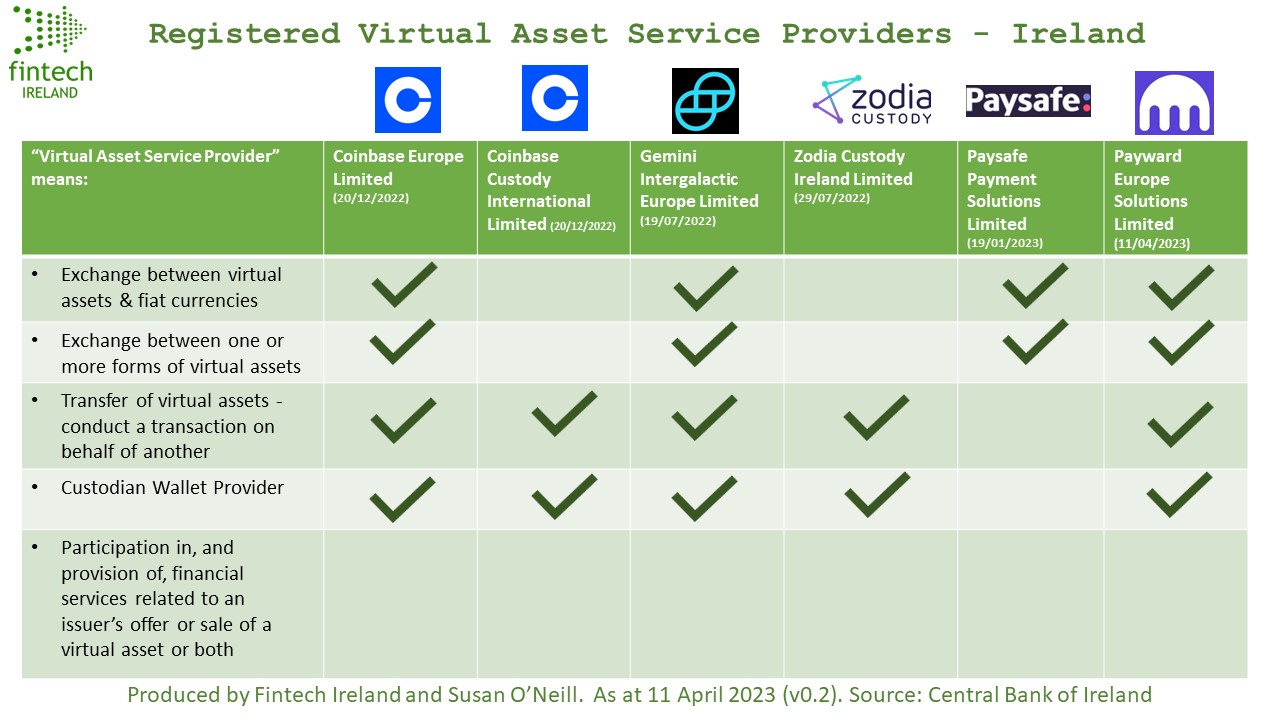
​The first registered VASP in Ireland was Gemini Intergalactic Europe Limited, registered on 19 July 2022 under its then name Gemini Digital Assets Limited. Next up was Zodia Custody Ireland Limited, registered on 29 July 2022, followed by both Coinbase Custody International Limited and Coinbase Europe Limited on 20 December 2022.  Paysafe Payment Solutions Limited joined these with a registration date of 19 January 2023.  The most recent VASP to appear on the CBI’s register is Payward Europe Solutions Limited (aka Kraken) whose registration appeared on 11 April 2023.

What services can VASPs offer? 

The services these VASPs are registered to provide is summarised in the table below.
Picture
​In recent months, many similarities have been drawn between the current crypto bear market and the dot com crash.  Many wrote off the collapse of US-based Silvergate Bank and Silicon Valley Bank as being completely different from previous financial crises.  However the failure of Credit Suisse - at one point in history the eighth-biggest publicly owned bank by market capitalisation - is making people wonder whether we are seeing the start of a financial crisis like that of 2008.  Increased regulatory scrutiny in the US continues to put pressure on the entire crypto market, regulators recently closed Signature Bank. Signature Bank and Silvergate Bank were widely used by crypto companies. With so much uncertainty there has never been a greater need for carefully considered regulation that will give crypto companies (and their banks) the clarity they need to operate in a compliant regulatory environment. There are many uphill battles ahead for the crypto ecosystem, only the strongest crypto firms will emerge successfully from this bear market. It will be interesting to see which VASP will appear next on the CBI’s register- watch this space!

The Central Bank of Ireland’s Governor’s recent comments on crypto – 25 January 2023

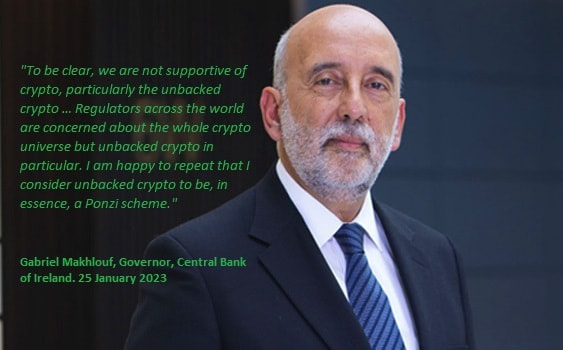
​There was widespread reporting in Irish and international media about comments made by Gabriel Makhlouf, the Governor of the Central Bank of Ireland during his appearance before a committee of Dail Eireann (lower house) in the Oireachtas (Irish Parliament) earlier this year.  Reuters reported that Mr Makhlouf urged lawmakers on to ban the advertising of crypto assets targeted at young adults and likened crypto not linked to any underlying assets to a Ponzi scheme saying “Unbacked crypto is essentially a Ponzi scheme... People who put their money into unbacked crypo, and most of the significant stock of crypto out there is unbacked, they are essentially gambling.”  Coindesk headlined with “the Governor Gabriel Makhlouf said crypto has ‘no social value whatsoever’”.  Whereas Bloomberg wrote “Makhlouf ‘Very Concerned’ About Crypto”.  
Picture
  • I would be grateful if customers could be warned in a very effective way as to the blatant risks of getting involved in crypto currencies in stark red letters: Governor Gabriel Makhlouf
​What did Governor Makhlouf actually say on 25 January this year?  You can read his comments before the Joint Committee on Finance, Public Expenditure and Reform, and Taoiseach here, where ‘crypto’ received 50 mentions during the exchange with members of the Oireachtas, including:
  • My views on crypto have developed. It is important to be clear because we all use the word "crypto" to mean certain things but there is a spectrum of things under that heading. At one end is what I would call unbacked crypto, which is crypto that has no link to any underlying assets and has no anchor to provide stability of value. It asserts that it is money but it is not a unit of account. It does not appear to be a means of exchange and it is certainly not a store of value. I am delighted the Deputy did not attach the word "currency" to crypto because I think this gives a misleading view of it. I only use the word "crypto". That unbacked currency has no social value whatsoever. Trying to ban it is probably unrealistic and may have unintended consequences. People who put their money in unbacked crypto, and probably the most significant stock of crypto out there is unbacked, are essentially gambling.
  • As you move along the spectrum, you get into backed crypto, which also goes under the name of stablecoin, but which has not proved to be particularly stable at the moment.
  • New EU legislation is coming in this year. The Markets in Crypto-Assets, MiCA, regulation will give us regulatory powers but it will not deal with unbacked crypto. It will deal with stablecoin.
  • I would be grateful if customers could be warned in a very effective way as to the blatant risks of getting involved in crypto currencies in stark red letters.
  • To be clear, we are not supportive of crypto, particularly the unbacked crypto … Regulators across the world are concerned about the whole crypto universe but unbacked crypto in particular. I am happy to repeat that I consider unbacked crypto to be, in essence, a Ponzi scheme.
  • The risks, especially with unbacked crypto right now, arise primarily with retail customers. We are not ignoring the fact that financial stability risks could arise in the future.
​You can make up your own mind on Governor Makhlouf thinking on crypto, and by extension the CBI’s position on same.

The UK FCA’s recent communication to overseas crypto industry – 5 April 2023​

Picture
On 5 April 2023, the UK FCA issued a letter to cryptoasset firms that market to UK consumers, including those based overseas to be aware that they will need to comply with the new UK financial promotions regime.  Set out in bold typeface the FCA warns the crypto industry that “The new UK financial promotions regime will apply to all firms making financial promotions of qualifying cryptoassets to UK consumers regardless of whether the firm is based overseas.”.  The letter issued by the FCA’s Val Smith (Head of Payments & Digital Assets, Authorisations) also reminded readers that financial promotions not falling under one of four permitted routes is a criminal offence punishable by up to 2 years imprisonment and/or a fine.  In the letter, the FCA reminded cryptoasset applicants that prior to submitting a registration application, they must ensure that they have provided all of the information requested in the application form.  The FCA also informed that in the two weeks following the 5 April letter, it will send cryptoasset firms a short on-line survey with questions about these firms’ UK businesses and their plans in response to the UK’s new financial promotions regime.  It looks like it will remain a busy time for cryptoasset and virtual asset services firms on the continent of Europe for the rest of 2023.
​
Enjoyed the article? Then please reach out to the Authors at their contact details below.

​About the Authors:

Susan O’Neill – CEO and Co-Founder of SuLu Solutions. Susan is a qualified accountant who has a wealth of expertise having held several senior management positions. SuLu solutions specialise in providing Fintechs with innovative digital asset strategy solutions that can help them stay ahead of the curve. Email [email protected].  Susan is on the Fintech Ireland Advisory Council.

Peter Oakes – Founder of Fintech Ireland and Fintech UK.  Peter is a board director of regulated MiFID, Emoney and Payments companies, and is an advisor to fintech and digital asset firms through international law firm Armstrong Teasdale and his specialist advisory business, CompliReg.  Email [email protected]
0 Comments
<<Previous
Forward>>

    Author

    Fintech Ireland

    Archives

    December 2026
    June 2026
    May 2026
    March 2026
    December 2025
    October 2025
    September 2025
    July 2025
    March 2025
    February 2025
    January 2025
    December 2024
    November 2024
    October 2024
    July 2024
    June 2024
    May 2024
    April 2024
    March 2024
    February 2024
    December 2023
    November 2023
    October 2023
    September 2023
    August 2023
    July 2023
    June 2023
    May 2023
    April 2023
    February 2023
    October 2022
    July 2022
    June 2022
    April 2022
    March 2022
    January 2022
    December 2021
    July 2021
    May 2021
    April 2021
    March 2021
    February 2021
    January 2021
    November 2020
    October 2020
    September 2020
    August 2020
    July 2020
    April 2020
    February 2020
    July 2019
    April 2019
    March 2019
    February 2019
    January 2019
    October 2018
    September 2018
    July 2018
    June 2018
    May 2018
    April 2018
    March 2018
    January 2018
    October 2017
    September 2017
    August 2017
    July 2017
    June 2017
    May 2017
    March 2017
    January 2017
    December 2016
    November 2016
    September 2016
    August 2016
    July 2016
    June 2016
    May 2016
    April 2016
    March 2016
    February 2016
    December 2015
    September 2015
    July 2015
    June 2015
    May 2015
    April 2015
    March 2015
    September 2014
    January 2014

    Categories

    All
    Account Information Services
    AISP
    Anne Boden
    Authorisations
    #bankinginquiry
    Bank Of England
    Bitcoin
    Brian Fahey
    British Embassy Dublin
    Business Post
    CB Insights
    Central Bank Of Ireland
    Challenger Bank
    Chambers And Partners
    Competition And Consumer Protection Commission
    Compliance
    Consultations
    Contributor Articles
    Corporate Governance
    Crowdingfunding
    Crypto Assets
    Cryptocurrencies
    Currency Fair
    Cyber Security
    DeFi
    Department Of Finance
    Digital Assets
    Digital Euro
    Digital Wallets
    Directors Duties
    Disruption
    Dogpatch Labs
    Electronic Money
    EML Payments
    EMoney
    European Commission
    Financial Literacy
    Fintech
    Fintech Abu Dhabi
    Fintech Hub
    Fintech Ireland
    Fintech Ireland Map
    Fintech Ireland Summit
    Fintech Leaders Series
    Funding
    Funds
    Gemini
    Ifs2020
    Ifsc
    Innovation
    International Financial Services Strategy
    Ireland For Finance
    Irish Fintech Companies
    John Berrigan
    Kraken
    Mairead McGuiness
    Marketplace
    MiCA
    Mifid
    Moneycorp
    Money Laundering
    Monzo Bank
    MoonPay
    MyComplianceOffice
    Neobanks
    Newsletter
    Nuapay
    @oakeslaw
    OFX Payments
    Paschal Donohue
    Payments
    Payments Institution
    Paysafe
    Payward
    Peer To Peer
    Peer-to-peer
    Realex Payments
    Regtech
    Regulated Fintech
    Regulation
    Roboadvisers
    Robo Advisors
    Robo-advisors
    Ronan Gallagher
    RTE
    Sandbox
    Sentenial
    Simon Harris
    Square
    SquareUp International
    Stablecoins
    Starling Bank
    Strategy
    SYNC Payments
    The Project Foundry
    TransferMate
    Unicorn
    Unicorns
    USA Today
    Virtual Assets
    Wealthtech
    Zodia Custody
    Zodia Markets

©Fintech Ireland and ©Fintech.  Fintech Ireland (523657) and Fintech (523656) are registered with the Companies Registration Office in Ireland
www.fintechireland.com / www.fintechireland.ie / www.irishfintech.ie / www.irishfintech.com / www.fintechcareers.ie
Privacy Policy