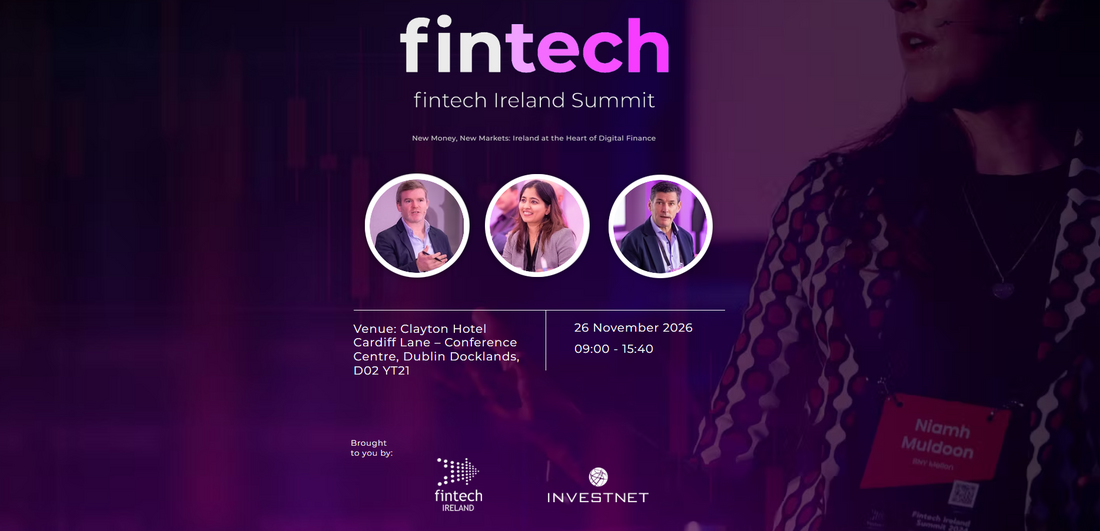
We have more than 220 attendees ranging from large international fintechs through to indigenous Irish start-ups in attendance represented by the who's who of c-suite executives from across the globe.
Read more here
| fintech IRELAND |
|
|
Following the success of the inaugural Fintech Ireland Summit in 2024 and 2025, the Summit returns in 2026.
We have more than 220 attendees ranging from large international fintechs through to indigenous Irish start-ups in attendance represented by the who's who of c-suite executives from across the globe. Read more here
0 Comments
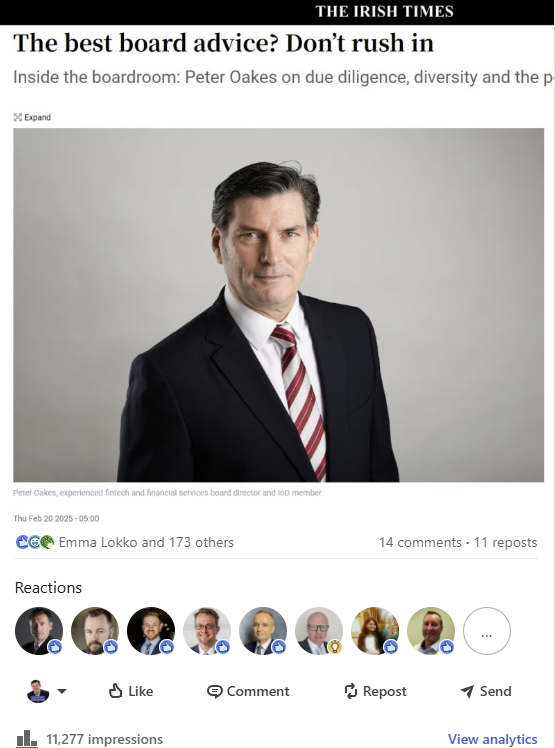
Inside the Fintech boardroom: Peter Oakes on due diligence, diversity and the power of a continuous learningPeter Oakes - Experienced Fintech and Financial Services Board Director Peter Oakes is a qualified solicitor, and has a background in regulation, governance, and compliance. Peter has held key positions at the Central Bank of Ireland and led initiatives in fintech. Peter Oakes is a founder of Fintech Ireland. What’s the most important advice you would give to someone considering a board position? Be selective and conduct thorough due diligence before accepting any board appointment. It’s not just about joining a club - it’s a serious responsibility. You need to understand the risks involved and ensure you can add unique value to the board. If you don’t have the right expertise or understanding, you could find yourself in the headlines for the wrong reasons. Boards thrive on diversity of thought and experience, so it’s essential to assess whether you bring something different to the table. How has your career in regulation and governance shaped your approach as a board director?My career began in regulation in Australia, where I witnessed firsthand how governance failures led to a corporate crisis and regulatory overhaul. I later worked with the UK Financial Services Authority (FSA) during its formation, and then as Director of Enforcement and Financial Crime at the Central Bank of Ireland during the financial crisis. Those experiences reinforced the importance of strong governance, regulatory compliance, and the role of independent directors in challenging management decisions. I bring that perspective to every board I serve on. How has Ireland’s fintech sector evolved, and what should NEDs consider before joining a fintech board? Ireland’s fintech success is partly due to the presence of major US tech firms, the availability of skilled professionals, and strong regulatory frameworks. There are now around 300 indigenous fintech firms and 140 international ones operating in Ireland. However, fintech moves fast, and that means risk. NEDs must be comfortable engaging with entrepreneurs who are scaling rapidly and sometimes breaking conventions. Regulators see risk in that, and it’s up to NEDs to ensure there is strong oversight. If you’re not prepared to challenge management or engage with investors, a fintech board might not be the right fit for you. What key skills and attributes make for an effective independent non-executive director (INED)? First, you need to be comfortable analysing financials - profit and loss statements, balance sheets, and cash flow reports. While you don’t have to be a chartered accountant, you must be able to ask the right questions. Independence of thought is also crucial. You’re not there as a cheerleader for management - you’re there to provide oversight and challenge decisions when necessary. Finally, understanding your regulatory obligations is key. If you’re not prepared to be questioned by a regulator, an INED role in financial services may not be for you. How has your IoD Ireland membership supported your journey as a board director?IoD Ireland has been invaluable to me. When I first joined in 2008, I was looking to deepen my understanding of Irish company law and governance. Completing the Chartered Director programme in 2009 was a great foundation for my board career. Beyond education, the networking opportunities have been exceptional. The IoD provides ongoing professional development, high-quality events, and access to a peer network that is incredibly useful for staying at the forefront of governance trends. The practical business value of membership is undeniable, especially for INEDs who need to stay CPD-compliant and informed.
By Peter Oakes, Founder Fintech Ireland.
As chair of two MiCAR firms authorised in the EU, I find this news today about Irish banks joining a stablecoin project very interesting. Wearing my INED hat at two EU emoney firms, I can understand the passion to reduce friction and costs in payments. Lots to unpack here for sure! AIB announces it has joined stablecoin project Qivalis. The other Irish bank that has joined the project is Bank of Ireland. The supervisory board of Qivalis is chaired by my former Financial Conduct Authority (then FSA) boss Sir Howard Davies who also served as Deputy Governor of the Bank of England and is a former Chair of RBS/NatWest Qivalis B.V., registered with the Dutch Trade Register under number 98235680. Subject to receiving regulatory approval, is targeting a market launch in the second half of 2026. It is a consortium of 37 leading European banks established to issue a regulated, euro-denominated compliant stablecoin that will enable seamless, efficient and secure payments and settlements within Europe and globally. AIB is one of 25 new members joining today (20 May 2026) the existing 12 banks already in the consortium as part of a major expansion. Qivalis: ➡️ desires on-chain ecosystem that positions a euro-denominated stablecoin as a global benchmark for digital finance. ➡️ seeks to enable the European finance sector to expand its digital infrastructure and build the future of European payments and settlements. ➡️ expects the euro stablecoin to be fully compliant with the EU's Markets in Crypto-Assets (#MiCAR) regulation. AIB’s collaboration is to further and strengthen its our ability to deliver payments innovation to its clients. Geraldine Casey, Managing Director Retail Banking at AIB said: “We are investing in this consortium because we believe Europe needs trusted, regulated innovation in payments and settlement... This investment aligns with that focus, the rapid transformation in payments and the growing development of blockchain and digital asset initiatives.” AIB claims that it invests around €400 million each year to become a digitally progressive bank. Meanwhile Billy O'Connell, Chief Strategy Officer at Bank of Ireland, said that through this initiative, Bank of Ireland is advancing innovation to deliver real benefits for customers, strengthen Europe’s financial infrastructure, and support the responsible development of digital money ...In doing so, we are helping to shape the future of how money moves, while supporting our ambition of offering unrivalled financial choice - now and for generations to come," Read more at:
My next guest is developing a technology that uses your face to make payments, which crucially bypasses the big American card payment systems such as MasterCard or Visa. Fintech Ireland caught up with leading Irish fintech startup FacePOS's James Hannigan (CEO) and Paddy Bolger (CFO) for a couple of post St Paddy Day pints at Doheny & Nesbitt in Dublin last night (Wednesday 18th March 2026). We and Fintech UK are very proud to have supported FacePOS on its journey thus far and we look forward to continuing to do so. This morning, Thursday 20th March 2026, James was interviewed in a short, concise and punchy interview on the future of payments and in particular a future without card schemes. James was introduced by the interviewer as "My next guest is developing a technology that uses your face to make payments, which crucially bypasses the big American card payment systems such as MasterCard or Visa." The Sligo-based FacePOS has been accepted into the Central Bank of Ireland's Sandbox scheme as part of FacePOS's mission to be accepted by the banks and retailers. James covered, among many other topics:
20260314 - Central Bank warns Irish crypto bosses over Iran war risk (Joe McCann & Peter Oakes)16/3/2026 If you require assistance with cybersecurity risks/cyber threats and operational resilience (DORA) issues in order to satisfy your Board's regulatory obligations to the CBI , reach out to Joe McCann at [email protected] (use reference CBI Dear CEO Letter 20260314) to initiate a no obligation discussion about how to conduct and/or interpret an appropriate cyber threat assessment. Intercept Technologies has assisted several regulated emoney institutions and CASPs both during and post CBI-authorisation to develop and complete cyber risk and DORA ICT Risk Assessment Questionnaires to the exacting standards expected by the Central Bank of Ireland which should be the same standard expected by your Board. Source, summary of the CBI Dear CEO Letter and audio podcast appear at the end of this blog. The Central Bank of Ireland is growing anxious about the risks to Irish crypto firms of the war in Iran. The regulator on Thursday wrote to chief executives of authorised Irish crypto asset service providers warning that the US-Israel strikes on Iran may have a “detrimental impact on crypto markets and firms’ ability to operate effectively”. The CBI questioned crypto firms about the impact the conflict – and the market turbulence that has followed – has had on their businesses. It also asked the chief executives if they have “assessed and stressed the potential impact of a prolonged war on the firm’s business model, profitability, and operations”, and whether they have conducted a cyber-risk assessment. “What actions are the firm taking to ensure the ongoing resilience of the firm’s business model, profitability and operations from global and geopolitical events?” the CBI asked. It gave crypto firms 24 hours to respond to its questions. The strikes on Iran by Israel and the US have worried investors over recent weeks, with stocks seesawing as oil prices have spiked. Bitcoin, the most valuable cryptocurrency by market cap, has outperformed gold and stocks since the beginning of the war. Bitcoin has risen about 7 per cent since the war started on February 28, trading at close to $72,000 on Friday afternoon. US investigators are looking at whether crypto platforms have enabled state-linked players to evade sanctions when seeking to move money abroad, access hard currency or procure goods, Reuters reported last month. TRM Labs, the American blockchain intelligence platform, has estimated that there was around $10 billion of crypto activity in Iran last year, against $11.4 billion in 2024. Joe McCann, managing director of Irish cybersecurity firm Intercept Technologies [and Intercept Fintech and Founder Crypto Assets Ireland], said the conflict presented “heightened risks” to crypto firms, including those in Ireland. McCann said he attended a recent supervisory briefing held by the CBI, adding: “They’re now talking more than they ever had about cyber resilience. “Ultimately, the risk posed to crypto asset service providers, even from a financial services aspect, is significantly higher than any others,” he said. “They’re constantly being targeted.” McCann said that for crypto firms, guarding against cyber attacks is no longer sufficient. “Protecting isn’t the only thing anymore,” he said. “It’s actually about monitoring and reporting.” Peter Oakes, the founder of Fintech Ireland, said it was “no great shock” that regulated crypto firms had received letters. “All of them have just passed through authorisation and should be treated like for like as other regulated fintech firms,” he said. “The letter is equally relevant to the trading desks of investment firms and some payments firms.” A spokesman for the CBI declined to comment on the specifics of its letter to crypto firms, but said the regulator is continuing to “monitor developments relevant to financial firms and services”. “The speed of current geopolitical developments calls for a clear understanding by firms and supervisors of the channels through which multi-faceted geopolitical risks can transmit to their organisations, and the consequent adaptability and resilience they need to nurture so they can respond to, and withstand, unexpected events,” he said. “This is a routine supervisory focus at a time of fast-moving global developments.” Source: https://www.businesspost.ie/banking/central-bank-warns-irish-crypto-bosses-over-iran-war-risk/ On Thursday 14th March 2026, the Central Bank of Ireland wrote to the CEOs of Crypto Asset Service Providers authorised in Ireland under the Markets in Crypto Assets Regulations.
The backdrop to the letter was "recent US-Israel strikes on Iran and related economic and financial markets impact". The CBI expressed its awareness that such events may have a detrimental impact on crypto markets and Firms’ ability to operate effectively. As a result, it requested that by close of business Friday 13 March 2026 the CEOs of CASPS respond to the CBI to a series of questions and providing relevant detail where necessary.
CASPs with questions are invited to contact the CBI. If you require assistance with cybersecurity risks/cyber threats and operational resilience (DORA) issues in order to satisfy your Board's regulatory obligations to the CBI , reach out to Joe McCann at [email protected] (use reference CBI Dear CEO Letter 20260314) to initiate a no obligation discussion about how to conduct and/or interpret an appropriate cyber threat assessment. Intercept Technologies has assisted several regulated emoney institutions and CASPs both during and post CBI-authorisation to develop and complete cyber risk and DORA ICT Risk Assessment Questionnaires to the exacting standards expected by the Central Bank of Ireland which should be the same standard expected by your Board. |
AuthorFintech Ireland Archives
December 2026
Categories
All
|