fintech IRELAND
email / social
  • Home
  • Fintech Authorisations
  • Fintech Education & Training
  • Fintech Ireland Map
    • Fintech Survey
  • Events
    • Summit
    • Events-Archive
  • Fintech Hub
  • News-Insights
    • Consultations
    • News Page Back Up
  • Careers
  • RegTech
  • CRYPTO
  • Fundraising
  • Brexit & Ireland
  • About
    • Fintech Family Network
  • Get Involved

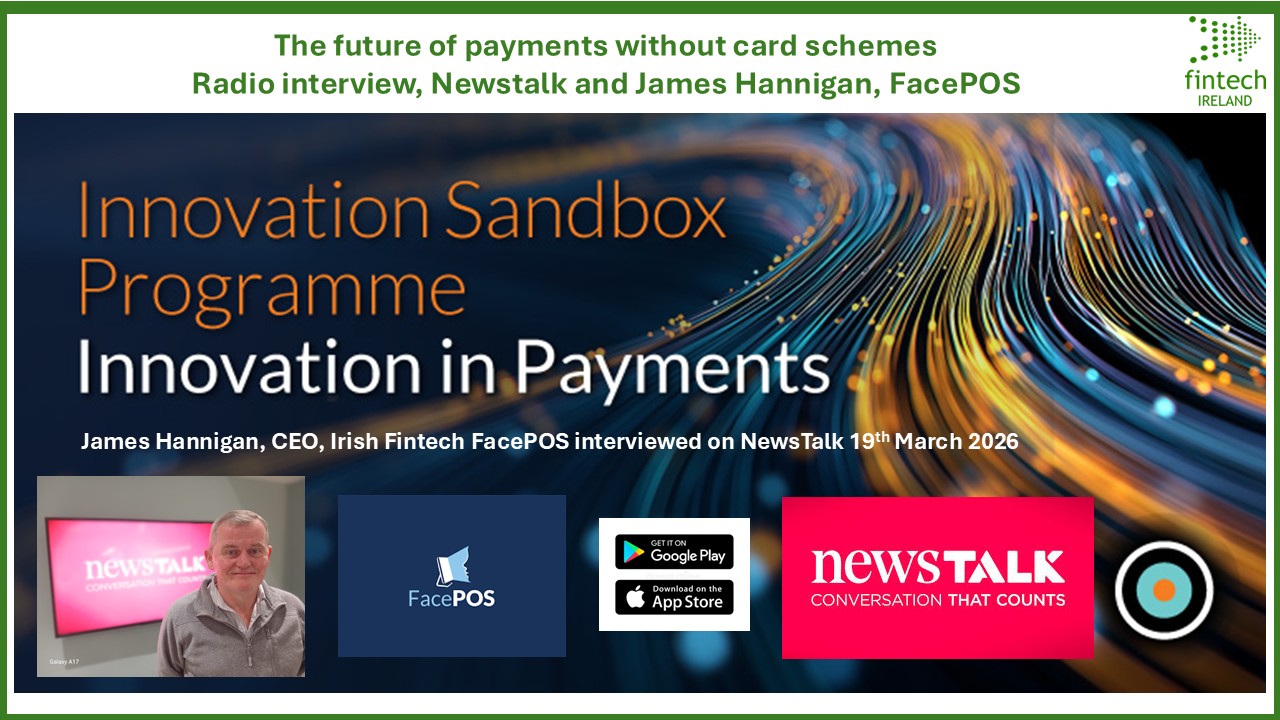
20260319 - The future of payments without card schemes Radio Interview. Newstalk and James Hannigan, FacePOS

19/3/2026

0 Comments

 
Picture
My next guest is developing a technology that uses your face to make payments, which crucially bypasses the big American card payment systems such as MasterCard or Visa.
Fintech Ireland caught up with leading Irish fintech startup FacePOS's James Hannigan (CEO) and Paddy Bolger (CFO) for a couple of post St Paddy Day pints at Doheny & Nesbitt in Dublin last night (Wednesday 18th March 2026).  We and Fintech UK are very proud to have supported FacePOS on its journey thus far and we look forward to continuing to do so.

This morning, Thursday 20th March 2026, James was interviewed in a short, concise and punchy interview on the future of payments and in particular a future without card schemes.

James was introduced by the interviewer as "My next guest is developing a technology that uses your face to make payments, which crucially bypasses the big American card payment systems such as MasterCard or Visa."

The Sligo-based FacePOS has been accepted into the Central Bank of Ireland's Sandbox scheme as part of FacePOS's mission to be accepted by the banks and retailers.

James covered, among many other topics:
  • how FacePOS has created a platform that allows both consumers and businesses to have FacePOS on their app and in their banking app.  This allows the customer to walk in, tap their phone using NFC to perform a customer bank account to merchant bank account transaction.
  • it's all about verification of paying, knowing who you're paying, knowing the amount of money you're paying to the business.
  • it's very, very important for Europe to have sovereignty in payments.
  • FacePOS will be showcasing further its app during the Central Bank of Ireland event on 25 June 2026.

Picture
LISTEN HERE

You can download the FacePOS app from Google Play and Apple Store to see what all the excitement is about.
Picture
0 Comments

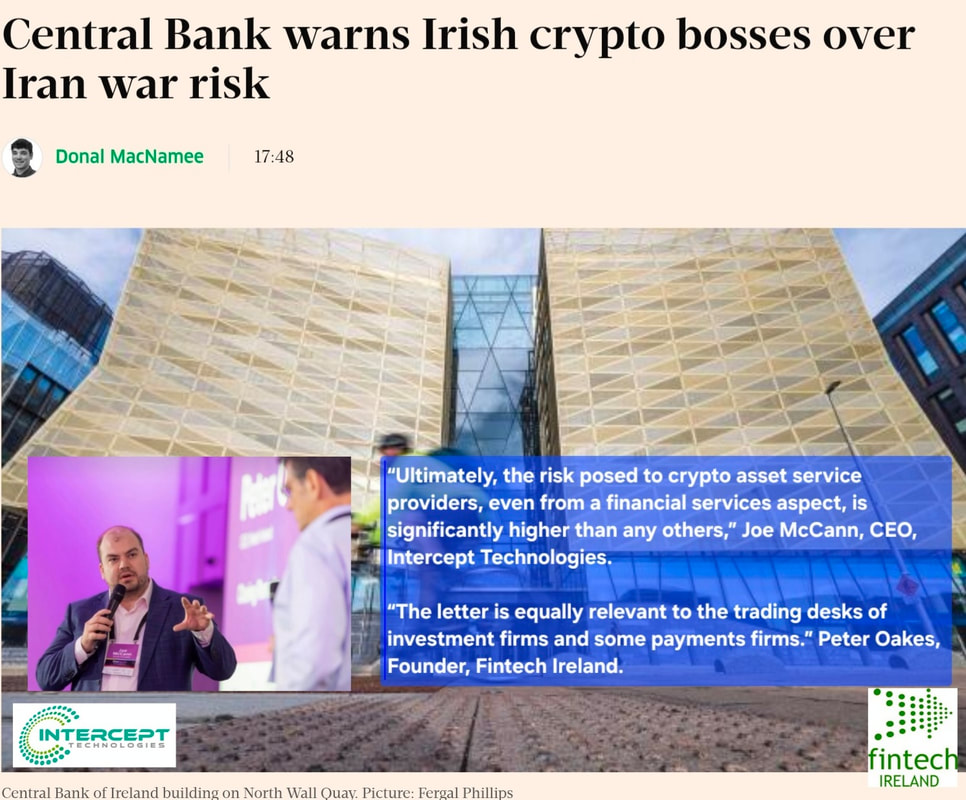
20260314 - Central Bank warns Irish crypto bosses over Iran war risk (Joe McCann & Peter Oakes)

16/3/2026

0 Comments

 
Picture
If you require assistance with cybersecurity risks/cyber threats and operational resilience (DORA) issues in order to satisfy your Board's regulatory obligations to the CBI , reach out to Joe McCann at [email protected] (use reference CBI Dear CEO Letter 20260314) to initiate a no obligation discussion about how to conduct and/or interpret an appropriate cyber threat assessment.  Intercept Technologies has assisted several regulated emoney institutions and CASPs both during and post CBI-authorisation to develop and complete cyber risk and DORA ICT Risk Assessment Questionnaires to the exacting standards expected by the Central Bank of Ireland which should be the same standard expected by your Board. 
Source, summary of the CBI Dear CEO Letter and audio podcast appear at the end of this blog.
The Central Bank of Ireland is growing anxious about the risks to Irish crypto firms of the war in Iran.
The regulator on Thursday wrote to chief executives of authorised Irish crypto asset service providers warning that the US-Israel strikes on Iran may have a “detrimental impact on crypto markets and firms’ ability to operate effectively”.

The CBI questioned crypto firms about the impact the conflict – and the market turbulence that has followed – has had on their businesses.

It also asked the chief executives if they have “assessed and stressed the potential impact of a prolonged war on the firm’s business model, profitability, and operations”, and whether they have conducted a cyber-risk assessment.

“What actions are the firm taking to ensure the ongoing resilience of the firm’s business model, profitability and operations from global and geopolitical events?” the CBI asked. It gave crypto firms 24 hours to respond to its questions.

The strikes on Iran by Israel and the US have worried investors over recent weeks, with stocks seesawing as oil prices have spiked.

Bitcoin, the most valuable cryptocurrency by market cap, has outperformed gold and stocks since the beginning of the war.

Bitcoin has risen about 7 per cent since the war started on February 28, trading at close to $72,000 on Friday afternoon.

US investigators are looking at whether crypto platforms have enabled state-linked players to evade sanctions when seeking to move money abroad, access hard currency or procure goods, Reuters reported last month.
​
TRM Labs, the American blockchain intelligence platform, has estimated that there was around $10 billion of crypto activity in Iran last year, against $11.4 billion in 2024.
Picture
Joe McCann, Managing Director, Intercept Technologies
Joe McCann, managing director of Irish cybersecurity firm Intercept Technologies, said the conflict presented “heightened risks” to crypto firms, including those in Ireland.
Joe McCann, managing director of Irish cybersecurity firm Intercept Technologies [and Intercept Fintech and Founder Crypto Assets Ireland], said the conflict presented “heightened risks” to crypto firms, including those in Ireland.

McCann said he attended a recent supervisory briefing held by the CBI, adding: “They’re now talking more than they ever had about cyber resilience.

“Ultimately, the risk posed to crypto asset service providers, even from a financial services aspect, is significantly higher than any others,” he said. “They’re constantly being targeted.”
​
McCann said that for crypto firms, guarding against cyber attacks is no longer sufficient.

“Protecting isn’t the only thing anymore,” he said. “It’s actually about monitoring and reporting.”
Peter Oakes, the founder of Fintech Ireland, said it was “no great shock” that regulated crypto firms had received letters.

“All of them have just passed through authorisation and should be treated like for like as other regulated fintech firms,” he said. “The letter is equally relevant to the trading desks of investment firms and some payments firms.”
Picture
“The letter is equally relevant to the trading desks of investment firms and some payments firms.”
A spokesman for the CBI declined to comment on the specifics of its letter to crypto firms, but said the regulator is continuing to “monitor developments relevant to financial firms and services”.

“The speed of current geopolitical developments calls for a clear understanding by firms and supervisors of the channels through which multi-faceted geopolitical risks can transmit to their organisations, and the consequent adaptability and resilience they need to nurture so they can respond to, and withstand, unexpected events,” he said.
​
“This is a routine supervisory focus at a time of fast-moving global developments.”
Picture
“This is a routine supervisory focus at a time of fast-moving global developments.”
Source: https://www.businesspost.ie/banking/central-bank-warns-irish-crypto-bosses-over-iran-war-risk/
Picture
Click Here To Listen

Picture
Central Bank of Ireland CASP Supervision Team Dear CEO Letter Thursday 14 March 2026
​On Thursday 14th March 2026, the Central Bank of Ireland wrote to the CEOs of Crypto Asset Service Providers authorised in Ireland under the Markets in Crypto Assets Regulations.

The backdrop to the letter was "recent US-Israel strikes on Iran and related economic and financial markets impact".  The CBI expressed its awareness that such events may have a detrimental impact on crypto markets and Firms’ ability to operate effectively.

As a result, it requested that by close of business Friday 13 March 2026 the CEOs of CASPS respond to the CBI to a series of questions and providing relevant detail where necessary.

  • the impact US-Israel strikes on Iran and related economic and financial markets impact is having on the CASP and where impacted, what actions is the Board taking to address any risks?
  • whether the CASP has assessed and stressed the potential impact of a prolonged war on the CASP's business model, profitability, and operations; if so, provide all relevant details.
  • has the CASP conducted / reviewed a cyber threat assessment?
  • with respect to the CASPs outsourced providers, third party providers (inclusive of group) or LPs (where relevant), has the CASP suffered any impact to its activities or operations as a result of the war or geo political events?;  if so, provide details including all actions taken by the CASP to address any risks.  
  • what actions is the CASP taking to ensure the ongoing resilience of the CASP's business model, profitability and operations from global and geo political events?
 
CASPs with questions are invited to contact the CBI.

If you require assistance with cybersecurity risks/cyber threats and operational resilience (DORA) issues in order to satisfy your Board's regulatory obligations to the CBI , reach out to Joe McCann at [email protected] (use reference CBI Dear CEO Letter 20260314) to initiate a no obligation discussion about how to conduct and/or interpret an appropriate cyber threat assessment.  Intercept Technologies has assisted several regulated emoney institutions and CASPs both during and post CBI-authorisation to develop and complete cyber risk and DORA ICT Risk Assessment Questionnaires to the exacting standards expected by the Central Bank of Ireland which should be the same standard expected by your Board. 

0 Comments

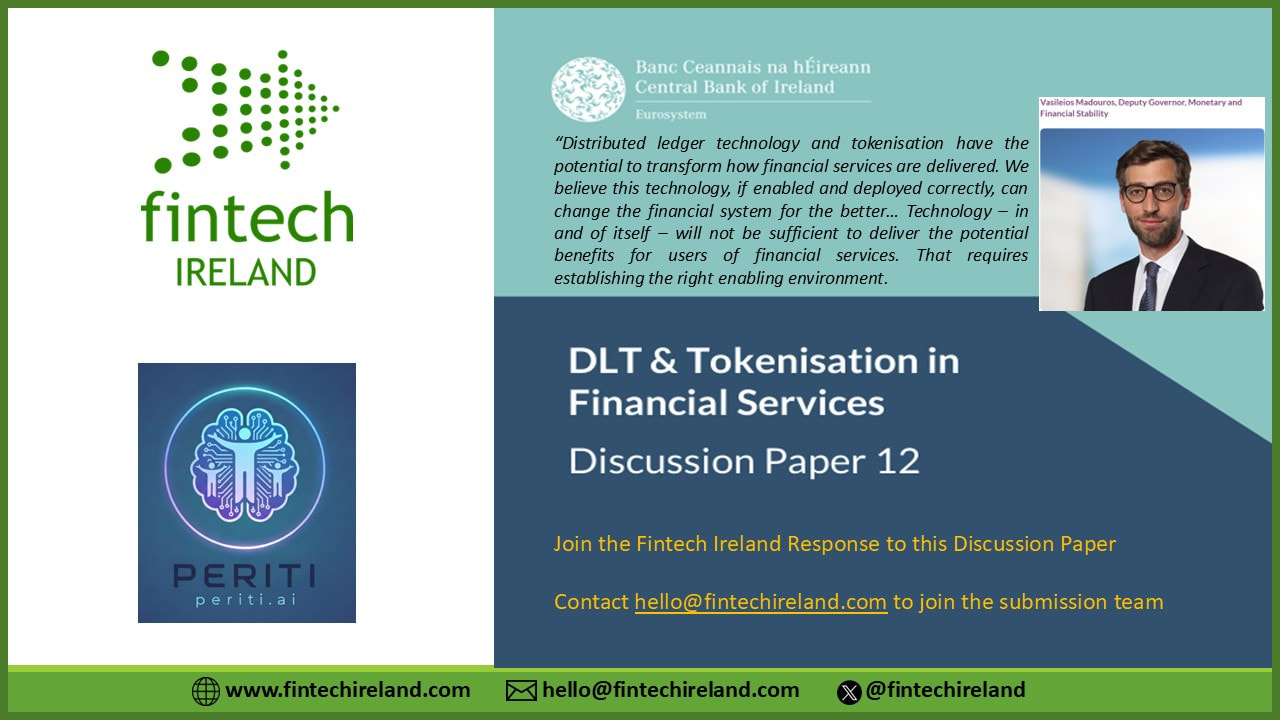
The Future of Digital Finance: An Analysis of the Central Bank of Ireland’s Discussion Paper 12 - Fintech Ireland & Periti AI

5/3/2026

0 Comments

 
By Peter Oakes, Fintech Ireland & Periti AI
www.fintechireland.com | www.periti.ai
Picture
About Peter Oakes:
Peter Oakes is a recognised expert in fintech, digital assets, and regulatory strategy. He is the founder of Fintech Ireland (www.fintechireland.com) and Periti AI (www.periti.ai), organisations dedicated to advancing the frontier of financial technology through deep industry insight and artificial intelligence. He is a director of several regulated financial services firms in the MiFID, CASP and Payments industries and is Board Adviser to Intercept Technologies Limited (a full suite cybersecurity governance, risk & compliance business also providing threat detection and prevention and penetration testing services to the regulated fintech community).
​As the financial landscape undergoes a radical shift toward digitisation, the Central Bank of Ireland (CBI) has released a pivotal Discussion Paper (DP 12) exploring the role of Distributed Ledger Technology (DLT) and tokenisation. At Fintech Ireland and Periti AI, we recognise this as a critical moment for the Irish and European ecosystems. This summary, prepared by Peter Oakes, explores the core themes of the paper, from structural benefits to the complex risk matrices that firms must now navigate.
1. Defining the New Frontier
The CBI defines DLT as a technological solution that achieves a single, shared "source of truth" via a common ledger. Peter Oakes highlights that this technology departs from current models that rely on multiple, fragmented databases requiring constant reconciliation.
The paper distinguishes between two types of tokens:
​
  • Digitally Native Tokens: Issued directly on a DLT.
  • Non-Native Tokens: Digital representations of existing assets issued elsewhere.
From the perspective of Periti AI, the diversity of DLT systems—categorised as public or private, and permissioned or permissionless—is the most significant factor for future governance.
2. Realising the Efficiency Gains
The CBI notes that conventional markets operate on a two-step model: trade execution followed by settlement. This introduces counterparty risk and adds time and cost. Peter Oakes observes that DLT can "collapse" these steps into a single, "atomic" process where trade and settlement occur simultaneously.
Key benefits identified by the CBI and emphasised by Fintech Ireland include:

  • 24/7/365 Availability: Near-instant settlement and continuous system uptime.
  • Fractionalisation: Dividing ownership into smaller digital units to broaden participation and increase liquidity in once-inaccessible assets.
  • Programmability: The use of smart contracts to automate corporate actions like dividend payments or collateral management.
3. The Seven Pillars of a Robust Enabling Environment
The CBI asserts that technology alone will not deliver these benefits. Peter Oakes identifies the seven critical enablers outlined in the paper that are essential for the Irish fintech sector:
  1. Legal and Regulatory Clarity: Establishing what represents an enforceable claim on a tokenised asset.
  2. Interoperability: Avoiding "walled gardens" by ensuring different DLT platforms can communicate through common standards.
  3. Tokenisation of Assets and Money: Ensuring both sides of a transaction (asset and payment) are on-chain to allow for atomic swaps.
  4. Settlement in Central Bank Money: The CBI insists that central bank money must remain the ultimate settlement asset to ensure financial stability.
  5. Operational Resilience: Adhering to the Digital Operational Resilience Act (DORA) to manage network congestion and cyber risks.
  6. Digital Identity: Implementing verifiable identity frameworks to prevent illicit activity.
  7. Transparent Governance: Ensuring clear accountability, especially in permissionless systems where no single entity currently holds responsibility.
4. Tokenisation in Markets and Fund
Ireland’s position as a global hub for investment funds makes the CBI's focus on this sector particularly relevant to Peter Oakes and the teams at Fintech Ireland and Periti AI.

The Fund Ecosystem
The CBI notes that Irish-authorised funds are already exploring "digital twin" models for share classes. Peter Oakes points out that tokenisation could automate fund workflows—such as eligibility checks and fee structures—through smart contracts.
​
Money Market Funds (MMFs) and ETFs
The paper highlights the rapid growth of Tokenised MMFs (TMMFs), which grew from $770 million in 2023 to nearly $10 billion by late 2025. Peter Oakes draws attention to the CBI's use cases, which suggest TMMFs could be used as high-speed collateral in margin arrangements. Similarly, tokenising ETFs could enable more automated "Delivery versus Payment" (DvP) processes.
5. The Evolution of Money and Payments
The CBI discusses the two-tier monetary system, where central bank money anchors the system and private banks issue deposits. Peter Oakes notes that this is evolving through:
  • Wholesale CBDCs: Initiatives like the Eurosystem’s "Pontes" (short-term) and "Appia" (long-term) projects to enable DLT settlement in central bank money.
  • Tokenised Deposits: A "promising" pathway for regulated banks to offer DLT efficiencies while maintaining existing consumer protections.
  • Stablecoins: Referred to by the CBI as "private settlement assets," these are growing fast but lack the deposit guarantees of traditional money.
6. Navigating the Risks
Peter Oakes and Periti AI emphasise that the CBI is not "technology agnostic" but actively monitoring new vulnerabilities. The paper categorises these risks as:
  • Disintermediation: Moving functions away from regulated entities like CSDs and toward private "validators" or "oracle" providers who may have weaker oversight.
  • Smart Contract Risk: Coding errors that can lead to irreversible asset loss.
  • Oracle Risk: Reliance on external data feeds which, if manipulated, can trigger incorrect liquidations.
  • Liquidity Fragmentation: The risk that having both tokenised and traditional versions of an asset could split liquidity and complicate price discovery.
7. Strategic Outlook and Next Steps
The CBI concludes that while risks are not necessarily higher than in traditional finance, they are "redistributed" across new actors and technologies. Peter Oakes notes that the Bank is seeking feedback by 5 June 2026.

At Fintech Ireland and Periti AI, we believe this Discussion Paper serves as a vital roadmap. The goal is to foster an ecosystem that balances the "brilliance" of technological innovation with the unwavering necessity of market integrity and consumer protection.
Picture
Picture
Wish to hear an AI generated podcast on this blog?
Long - Audio Podcast
Short - Audio Podcast 
 

Click the Listen Button?

Looking for the Discussion Paper?  CLICK HERE
Looking for the Central Bank of Ireland Announcement?  CLICK HERE

0 Comments

    Author

    Fintech Ireland

    Archives

    December 2026
    May 2026
    March 2026
    December 2025
    October 2025
    September 2025
    July 2025
    March 2025
    February 2025
    January 2025
    December 2024
    November 2024
    October 2024
    July 2024
    June 2024
    May 2024
    April 2024
    March 2024
    February 2024
    December 2023
    November 2023
    October 2023
    September 2023
    August 2023
    July 2023
    June 2023
    May 2023
    April 2023
    February 2023
    October 2022
    July 2022
    June 2022
    April 2022
    March 2022
    January 2022
    December 2021
    July 2021
    May 2021
    April 2021
    March 2021
    February 2021
    January 2021
    November 2020
    October 2020
    September 2020
    August 2020
    July 2020
    April 2020
    February 2020
    July 2019
    April 2019
    March 2019
    February 2019
    January 2019
    October 2018
    September 2018
    July 2018
    June 2018
    May 2018
    April 2018
    March 2018
    January 2018
    October 2017
    September 2017
    August 2017
    July 2017
    June 2017
    May 2017
    March 2017
    January 2017
    December 2016
    November 2016
    September 2016
    August 2016
    July 2016
    June 2016
    May 2016
    April 2016
    March 2016
    February 2016
    December 2015
    September 2015
    July 2015
    June 2015
    May 2015
    April 2015
    March 2015
    September 2014
    January 2014

    Categories

    All
    Account Information Services
    AISP
    Anne Boden
    Authorisations
    #bankinginquiry
    Bank Of England
    Bitcoin
    Brian Fahey
    British Embassy Dublin
    Business Post
    CB Insights
    Central Bank Of Ireland
    Challenger Bank
    Chambers And Partners
    Competition And Consumer Protection Commission
    Compliance
    Consultations
    Contributor Articles
    Corporate Governance
    Crowdingfunding
    Crypto Assets
    Cryptocurrencies
    Currency Fair
    Cyber Security
    DeFi
    Department Of Finance
    Digital Assets
    Digital Euro
    Digital Wallets
    Directors Duties
    Disruption
    Dogpatch Labs
    Electronic Money
    EML Payments
    EMoney
    European Commission
    Financial Literacy
    Fintech
    Fintech Abu Dhabi
    Fintech Hub
    Fintech Ireland
    Fintech Ireland Map
    Fintech Ireland Summit
    Fintech Leaders Series
    Funding
    Funds
    Gemini
    Ifs2020
    Ifsc
    Innovation
    International Financial Services Strategy
    Ireland For Finance
    Irish Fintech Companies
    John Berrigan
    Kraken
    Mairead McGuiness
    Marketplace
    MiCA
    Mifid
    Moneycorp
    Money Laundering
    Monzo Bank
    MoonPay
    MyComplianceOffice
    Neobanks
    Newsletter
    Nuapay
    @oakeslaw
    OFX Payments
    Paschal Donohue
    Payments
    Payments Institution
    Paysafe
    Payward
    Peer To Peer
    Peer-to-peer
    Realex Payments
    Regtech
    Regulated Fintech
    Regulation
    Roboadvisers
    Robo Advisors
    Robo-advisors
    Ronan Gallagher
    RTE
    Sandbox
    Sentenial
    Simon Harris
    Square
    SquareUp International
    Stablecoins
    Starling Bank
    Strategy
    SYNC Payments
    The Project Foundry
    TransferMate
    Unicorn
    Unicorns
    USA Today
    Virtual Assets
    Wealthtech
    Zodia Custody
    Zodia Markets

©Fintech Ireland and ©Fintech.  Fintech Ireland (523657) and Fintech (523656) are registered with the Companies Registration Office in Ireland
www.fintechireland.com / www.fintechireland.ie / www.irishfintech.ie / www.irishfintech.com / www.fintechcareers.ie
Privacy Policy