By Peter Oakes, Fintech Ireland & Periti AI
About Peter Oakes:
Peter Oakes is a recognised expert in fintech, digital assets, and regulatory strategy. He is the founder of Fintech Ireland (www.fintechireland.com) and Periti AI (www.periti.ai), organisations dedicated to advancing the frontier of financial technology through deep industry insight and artificial intelligence. He is a director of several regulated financial services firms in the MiFID, CASP and Payments industries and is Board Adviser to Intercept Technologies Limited (a full suite cybersecurity governance, risk & compliance business also providing threat detection and prevention and penetration testing services to the regulated fintech community).
Peter Oakes is a recognised expert in fintech, digital assets, and regulatory strategy. He is the founder of Fintech Ireland (www.fintechireland.com) and Periti AI (www.periti.ai), organisations dedicated to advancing the frontier of financial technology through deep industry insight and artificial intelligence. He is a director of several regulated financial services firms in the MiFID, CASP and Payments industries and is Board Adviser to Intercept Technologies Limited (a full suite cybersecurity governance, risk & compliance business also providing threat detection and prevention and penetration testing services to the regulated fintech community).
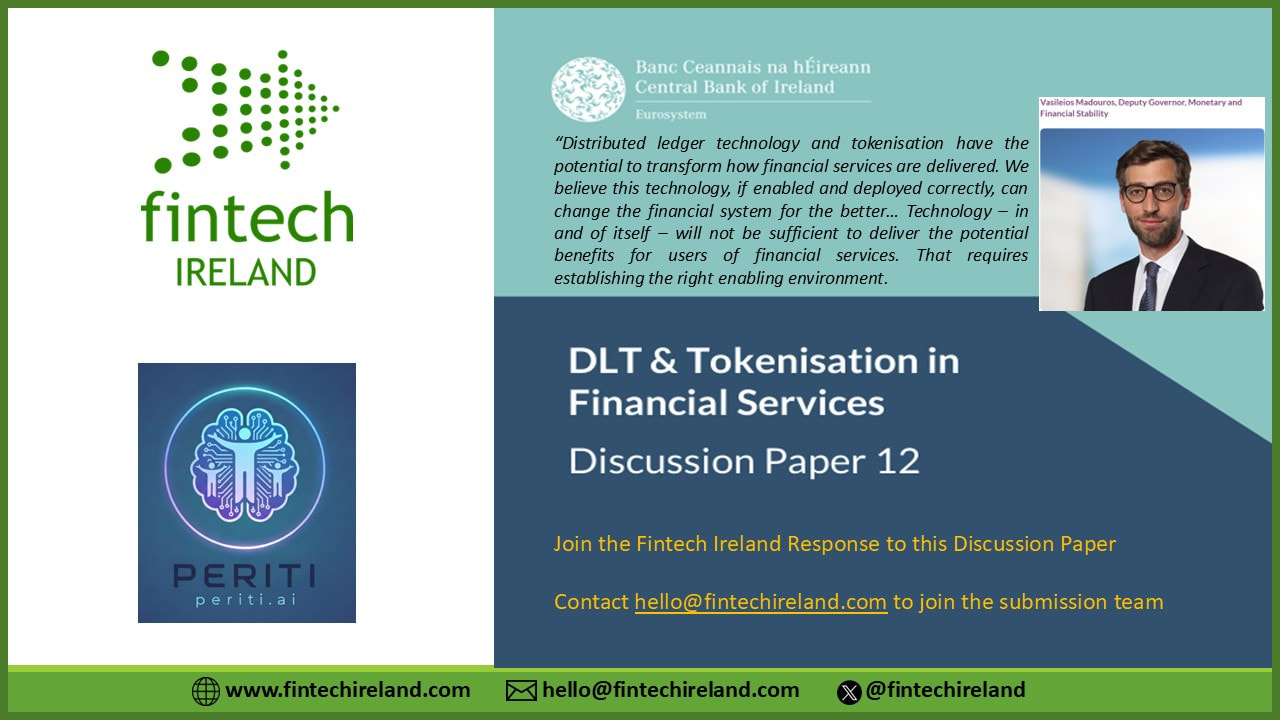
As the financial landscape undergoes a radical shift toward digitisation, the Central Bank of Ireland (CBI) has released a pivotal Discussion Paper (DP 12) exploring the role of Distributed Ledger Technology (DLT) and tokenisation. At Fintech Ireland and Periti AI, we recognise this as a critical moment for the Irish and European ecosystems. This summary, prepared by Peter Oakes, explores the core themes of the paper, from structural benefits to the complex risk matrices that firms must now navigate.
1. Defining the New Frontier
The CBI defines DLT as a technological solution that achieves a single, shared "source of truth" via a common ledger. Peter Oakes highlights that this technology departs from current models that rely on multiple, fragmented databases requiring constant reconciliation.
The paper distinguishes between two types of tokens:
The paper distinguishes between two types of tokens:
- Digitally Native Tokens: Issued directly on a DLT.
- Non-Native Tokens: Digital representations of existing assets issued elsewhere.
2. Realising the Efficiency Gains
The CBI notes that conventional markets operate on a two-step model: trade execution followed by settlement. This introduces counterparty risk and adds time and cost. Peter Oakes observes that DLT can "collapse" these steps into a single, "atomic" process where trade and settlement occur simultaneously.
Key benefits identified by the CBI and emphasised by Fintech Ireland include:
Key benefits identified by the CBI and emphasised by Fintech Ireland include:
- 24/7/365 Availability: Near-instant settlement and continuous system uptime.
- Fractionalisation: Dividing ownership into smaller digital units to broaden participation and increase liquidity in once-inaccessible assets.
- Programmability: The use of smart contracts to automate corporate actions like dividend payments or collateral management.
3. The Seven Pillars of a Robust Enabling Environment
The CBI asserts that technology alone will not deliver these benefits. Peter Oakes identifies the seven critical enablers outlined in the paper that are essential for the Irish fintech sector:
- Legal and Regulatory Clarity: Establishing what represents an enforceable claim on a tokenised asset.
- Interoperability: Avoiding "walled gardens" by ensuring different DLT platforms can communicate through common standards.
- Tokenisation of Assets and Money: Ensuring both sides of a transaction (asset and payment) are on-chain to allow for atomic swaps.
- Settlement in Central Bank Money: The CBI insists that central bank money must remain the ultimate settlement asset to ensure financial stability.
- Operational Resilience: Adhering to the Digital Operational Resilience Act (DORA) to manage network congestion and cyber risks.
- Digital Identity: Implementing verifiable identity frameworks to prevent illicit activity.
- Transparent Governance: Ensuring clear accountability, especially in permissionless systems where no single entity currently holds responsibility.
4. Tokenisation in Markets and Fund
Ireland’s position as a global hub for investment funds makes the CBI's focus on this sector particularly relevant to Peter Oakes and the teams at Fintech Ireland and Periti AI.
The Fund Ecosystem
The CBI notes that Irish-authorised funds are already exploring "digital twin" models for share classes. Peter Oakes points out that tokenisation could automate fund workflows—such as eligibility checks and fee structures—through smart contracts.
Money Market Funds (MMFs) and ETFs
The paper highlights the rapid growth of Tokenised MMFs (TMMFs), which grew from $770 million in 2023 to nearly $10 billion by late 2025. Peter Oakes draws attention to the CBI's use cases, which suggest TMMFs could be used as high-speed collateral in margin arrangements. Similarly, tokenising ETFs could enable more automated "Delivery versus Payment" (DvP) processes.
The Fund Ecosystem
The CBI notes that Irish-authorised funds are already exploring "digital twin" models for share classes. Peter Oakes points out that tokenisation could automate fund workflows—such as eligibility checks and fee structures—through smart contracts.
Money Market Funds (MMFs) and ETFs
The paper highlights the rapid growth of Tokenised MMFs (TMMFs), which grew from $770 million in 2023 to nearly $10 billion by late 2025. Peter Oakes draws attention to the CBI's use cases, which suggest TMMFs could be used as high-speed collateral in margin arrangements. Similarly, tokenising ETFs could enable more automated "Delivery versus Payment" (DvP) processes.
5. The Evolution of Money and Payments
The CBI discusses the two-tier monetary system, where central bank money anchors the system and private banks issue deposits. Peter Oakes notes that this is evolving through:
- Wholesale CBDCs: Initiatives like the Eurosystem’s "Pontes" (short-term) and "Appia" (long-term) projects to enable DLT settlement in central bank money.
- Tokenised Deposits: A "promising" pathway for regulated banks to offer DLT efficiencies while maintaining existing consumer protections.
- Stablecoins: Referred to by the CBI as "private settlement assets," these are growing fast but lack the deposit guarantees of traditional money.
6. Navigating the Risks
Peter Oakes and Periti AI emphasise that the CBI is not "technology agnostic" but actively monitoring new vulnerabilities. The paper categorises these risks as:
- Disintermediation: Moving functions away from regulated entities like CSDs and toward private "validators" or "oracle" providers who may have weaker oversight.
- Smart Contract Risk: Coding errors that can lead to irreversible asset loss.
- Oracle Risk: Reliance on external data feeds which, if manipulated, can trigger incorrect liquidations.
- Liquidity Fragmentation: The risk that having both tokenised and traditional versions of an asset could split liquidity and complicate price discovery.
7. Strategic Outlook and Next Steps
The CBI concludes that while risks are not necessarily higher than in traditional finance, they are "redistributed" across new actors and technologies. Peter Oakes notes that the Bank is seeking feedback by 5 June 2026.
At Fintech Ireland and Periti AI, we believe this Discussion Paper serves as a vital roadmap. The goal is to foster an ecosystem that balances the "brilliance" of technological innovation with the unwavering necessity of market integrity and consumer protection.
At Fintech Ireland and Periti AI, we believe this Discussion Paper serves as a vital roadmap. The goal is to foster an ecosystem that balances the "brilliance" of technological innovation with the unwavering necessity of market integrity and consumer protection.

Wish to hear an AI generated podcast on this blog?
Long - Audio Podcast
Short - Audio Podcast
Click the Listen Button?
Looking for the Discussion Paper? CLICK HERE
Looking for the Central Bank of Ireland Announcement? CLICK HERE
Long - Audio Podcast
Short - Audio Podcast
Click the Listen Button?
Looking for the Discussion Paper? CLICK HERE
Looking for the Central Bank of Ireland Announcement? CLICK HERE