fintech IRELAND
email / social
  • Home
  • Fintech Authorisations
  • Fintech Education & Training
  • Fintech Ireland Map
    • Fintech Survey
  • Events
    • Summit
    • Events-Archive
  • Fintech Hub
  • News-Insights
    • Consultations
    • News Page Back Up
  • Careers
  • RegTech
  • CRYPTO
  • Fundraising
  • Brexit & Ireland
  • About
    • Fintech Family Network
  • Get Involved

20240409 - New/Updated Central Bank Expectations for Authorisation as a Payment Institution or Electronic Money Institution, or Registration as an Account Information Service Provider

9/4/2024

0 Comments

 
Sign up to our Newsletter here.​
  • Need assistance with an emoney or payments authorisation or an account information service provider or virtual asset services provider registration application, contact CompliReg.com at [email protected].
  • Check out Fintech Ireland and CompliReg's handy authorisation guides at https://fintechireland.com/fintech-authorisations.html.  
This blog and others are joint efforts between Fintech Ireland and CompliReg.
Picture
First Published Tuesday 9th April 2024

Before we dive into the detail contained in the new (issued 9 April 2024) "Central Bank Expectations for Authorisation as a Payment Institution or Electronic Money Institution, or Registration as an Account Information Service Provider", a couple of things to note:
​
  1. the format, look and feel of the new webpage on the CBI's website;
  2. the links from How We Regulate leading to the Authorisation Page, regardless if you clicked on Payments Institutions, Electronic Money Institutions, Small Electronic Money Institutions or Account Information Service Providers redirect you to the same page. That page ends in payment-authorisation.  Seems that from a pragmatic and practical stance, the CBI is getting ready for the merging of the e-money and payment services regimes under the current PSD3 legislative proposal;
  3. [12+ months for authorisation] although buried away at the bottom of the CBI's webpage, there is this very welcome statement about how long it may take to get authorised. "Experience suggests that it can take over 12 months for firms to provide all of the information necessary to enable a decision to be made" ;
  4. [requirement for a pre-application meeting] each proposed Applicant must meet with the CBI before an Application is filed;
  5. [no triple hatting] the Central Bank informs that it has not approved applications which propose triple hatting.  It also states that "Proposals to triple hat roles present significant doubt as to the commitment of an applicant firm to have adequate governance in place."
  6. [dual hatting].  Dual hatting is permissible on a case-by-case basis, depending on the nature, scale and complexity of the proposal, and insofar as there is no potential or perceived blurring of the three lines of defence. Any proposal for dual hatting of PCF roles should be accompanied by a detailed rationale setting out how the role holder would have sufficient capacity, and the appropriate qualifications/experience, to effectively perform the proposed roles.
  7. [appointment of CEO, chair & others] the Central Bank states that "the appropriateness of resources will be determined at each stage on a case-by-case basis, applicant firms which have made senior appointments (for example Chair and Chief Executive Officer) at the application point tend to progress through the authorisation process in a more timely manner.". The Central bank also states that "Applicant firms which have made the necessary senior appointments early in the process generally submit a more complete application and, therefore, tend to progress through the assessment process in a timelier manner."
  8. currently, there is no fee for submitting an Application (but there is of a course the separate Industry Funding Levy);
  9. Dormancy Policy - the CBI's dormancy policy applies when an applicant has not provided an adequate response within 60 working days following the issuance of comments. A “Minded to Deem Withdrawn” letter is sent to the applicant after 50 working days of comments issued, notifying the applicant that it has 10 working days to provide all outstanding documentation or the application will be considered withdrawn. If the applicant does not respond within the 10 working days, a “Deemed Withdrawn” letter is sent and the application is not considered further by the CBI.    
Now that we have covered the burning issues on most applicants' mind, let's turn to what the CBI has set out in its new/updated "Expectations for Authorisation as a Payment Institution or Electronic Money Institution, or Registration as an Account Information Service Provider"
THE FOLLOWING IS WHAT THE CENTRAL BANK OF IRELAND SAYS ABOUT ITS AUTHORISATION PROCESS AND REGISTRATION PROCESS FOR THESE TYPES OF FIRMS
Applicant firms seeking to operate in the Irish market and bring innovation to customers reasonably look to be authorised in a timely manner.  The Central Bank’s intent is that there is clarity, transparency and predictability for applicant firms looking to be authorised/registered, while maintaining the high standards the public expects for regulated providers of financial services.  It is the Central Bank’s objective to support applicant firms in understanding their obligations, resulting in applications which are more complete and can, in turn, be assessed more quickly by authorisations staff. 
Picture
It is important to read the Central Bank Expectations for Authorisation as a Payment Institution or Electronic Money Institution, or Registration as an Account Information Service Provider. Issued 9 April 2024
Picture
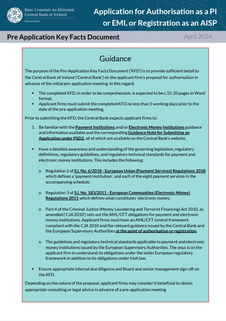
Referred to below is the Pre-Application Key Facts Document (“KFD”). The purpose of the KFD is to provide sufficient detail to the CBI on an applicant's proposal for authorisation/registration.  It would normally consist of c.15-20 pages. It should be included in first batch of documents an Applicant reads. Issued 9 April 2024.
Picture
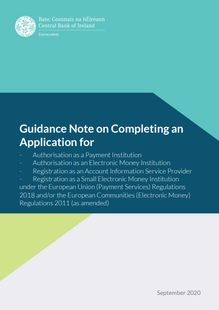
A document that should be read along-side the above Expectations document is the CBI's Guidance Note on Completing an Application for Authorisation under PSD2. Issued September 2020
Referred to below is the Pre-Application Key Facts Document (“KFD”). Issued 9 April 2024. The purpose of the KFD is to provide sufficient detail to the CBI on an applicant's proposal for authorisation/registration.  It would normally consist of c.15-20 pages. It should be included in first batch of documents an Applicant reads.
Picture
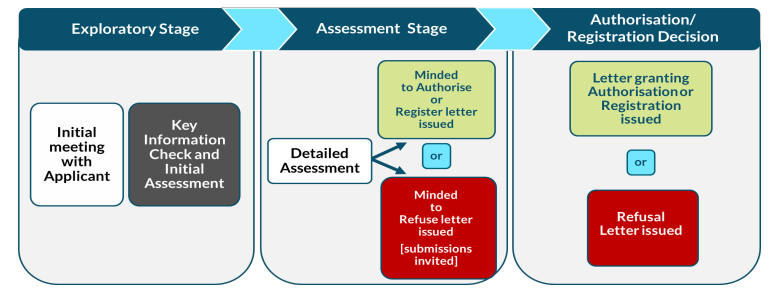
As you will note from the above diagram, the authorisation assessment process consists of the following three stages:

1. Exploratory Stage. This consists of two phases:
  • Initial meeting with the applicant firm; and
  • Submission of required information (Key Information Check) and initial assessment;

2. Assessment Stage; and

3. Authorisation/Registration Decision Stage.
Stage 1: Exploratory Stage
Phase 1 – Initial Meeting
Firms seeking to pursue an application for authorisation as a Payment Institution or Electronic Money Institution or seeking registration as an Account Information Service Provider should contact the Payments Authorisation Team ([email protected]) to arrange an initial  meeting.  

In advance of the initial meeting, the Pre-Application Key Facts Document (“KFD”) must be completed. The purpose of the KFD is to provide sufficient detail to the Central Bank on the applicant firm’s proposal for authorisation/registration in advance of the initial meeting. In order to provide sufficient detail to the Central Bank, it is expected that the KFD would consist of c.15-20 pages in MS Word format.

The completed KFD should be submitted at least 5 working days in advance of the initial meeting to [email protected].

The initial meeting provides an opportunity to discuss the contents of the KFD and enables the applicant to raise any questions it might have regarding the authorisation/registration process and the requirements pertaining to the proposed business model.

The meeting also provides the Central Bank with the opportunity to:


  • provide greater clarity in relation to the assessment process, and the requirements for authorisation/registration;
  • identify any initial matters with the proposal which, if not addressed, would preclude the application from proceeding; and
  • highlight any issues/areas of focus which need to be specifically addressed in an application.

The initial meeting complements the early engagement route via the Central Bank Innovation Hub and the Innovation Sandbox Programme are designed as resources to help innovators navigate the regulatory landscape.
Phase 2 – Key Information Check and Initial Assessment

In addition to ensuring that all required documentation has been provided, this phase encompasses an initial assessment of the submission.

At the end of this phase, the Central Bank will notify the firm of the outcome which is either:

  • Progression
The Central Bank considers that the application can progress to the Assessment Stage.  A specific case manager is assigned who will lead the assessment, and will be the primary point of contact for the applicant firm during the assessment process.
  • Issues have been Identified Precluding Progression
The Central Bank considers that the application cannot progress to the Assessment Stage.  The applicant will be advised as to the rationale for not progressing and will be provided with an opportunity to address the issues identified (through written submissions and/or meetings).
Stage 2: Assessment Stage
During this stage the Central Bank conducts its assessment of the application. The Central Bank may request additional information, and detailed assessment meetings in relation to one or more areas of the application will be undertaken with the applicant. High quality applications with comprehensive and complete information and explanations reduce the need for additional information requests. Individuals proposed for certain key roles (Pre-Approval Controlled Function roles) may be invited for interview as part of the assessment of their Fitness and Probity for the role for which they are applying.

At the end of the assessment process, the Central Bank will notify the firm of the outcome of its assessment. There are two possible outcomes:
​
  • Positive Outcome (“Minded To Authorise/Register” letter)
Where the applicant firm has positively demonstrated that it will meet all authorisation/ registration requirements and expectations, the Central Bank will issue a “Minded to Authorise/Register” letter which will include, inter alia, requirements to be addressed prior to authorisation/registration, conditions to be addressed post-authorisation, and the proposed level of capital to be held (neither conditions nor capital are applicable to Account Information Service Providers).

or
  • Negative Outcome (“Minded to Refuse” letter)
In the event that the Central Bank is not satisfied following the conclusion of its assessment phase that it can authorise/register the firm, a “Minded to Refuse” letter will be issued. This will include the reason(s) for the Central Bank’s proposed decision. The letter will specify the period within which the applicant firm may make submissions in writing in relation to the proposed refusal. Any submissions made will be considered by the Central Bank before making a decision on the matter.
Stage 3: Authorisation/Registration Decision
This is the stage in which the final decision as to authorisation/registration is made. There are two possible outcomes:

  • Positive Outcome (Letter Granting Authorisation/Registration)
Subject to the pre-authorisation/registration requirements in the “Minded to Authorise” letter having been addressed, no new adverse information coming to the Central Bank’s attention in the interim, and agreement from the applicant firm as to the proposed conditions and capital (not applicable to Account Information Service Providers), a letter granting authorisation/registration will be issued, and the applicant firm will then be able to commence its regulated activities.

or
​
  • Negative Outcome (Letter of Refusal)
Where a “Minded to Refuse” letter has issued, the Central Bank will review any submissions made by the applicant firm. If the Central Bank is still not satisfied to approve an application following the review of any submissions to a ‘Minded to Refuse’ letter, it will issue a letter of refusal.
How does the CBI measure the performance of the Authorisation/Registration Process?
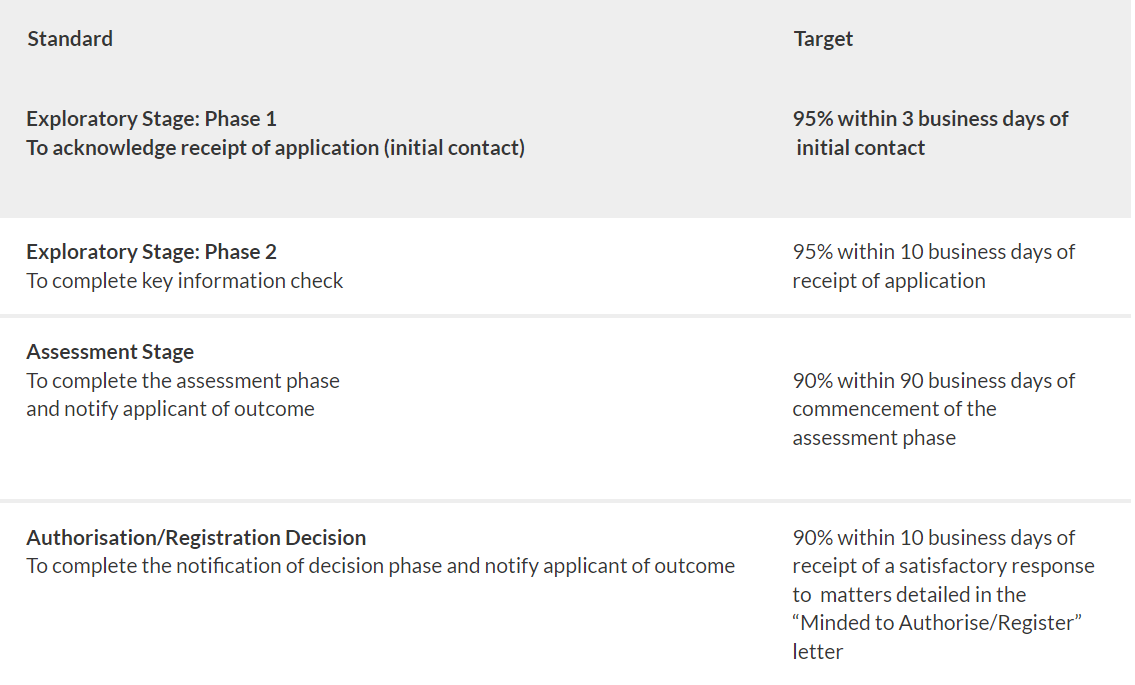
The CBI has published service standards in respect of the processing of applications for authorisation of Payment and Electronic Money Institutions and registration of Account Information Service Providers as follows:
Picture
​The 90 day Service Standard clock for the Assessment Stage will be paused where an information request has been issued to the applicant until such time as a satisfactory response has been provided. In addition, the clock can be switched off entirely where any of the following arise:
​
  • Another regulatory authority has to be contacted;
  • Persons are subject to interview;
  • Significant legal issues arise;
  • Significant fitness and probity issues arise;
  • The business model is complex or novel in nature;
  • Significant changes to the business model, the applicant’s shareholder structure or other key aspects of an application arise during the review process, or where the application becomes dormant; or
  • The CBI is minded to refuse an application.  
Can my application go stale / become dormant?
The CBI has Dormancy Policy.

This means that when an applicant has not provided an adequate response within 60 working days following the issuance of comments. A “Minded to Deem Withdrawn” letter is sent to the applicant after 50 working days of comments issued, notifying the applicant that it has 10 working days to provide all outstanding documentation or the application will be considered withdrawn. If the applicant does not respond within the 10 working days, a “Deemed Withdrawn” letter is sent and the application is not considered further by the Central Bank.
Does the CBI allow the registration of Small Electronic Money Institutions?  
Yes it does.  However to date the CBI has not registered any Small Electronic Money Institutions. If you intend seeking registration as a Small Electronic Money Institution, as defined in Regulation 33 of the European Communities (Electronic Money) Regulations 2011 (as amended), should contact the Payments Authorisation Team ([email protected]).
Does the CBI allow the registration of Small Payment Institutions?  
There is no small payment institution regime in place in Ireland, and firms wishing to provide payment services are required to apply for authorisation as a payment institution.
  1. Expectations for Authorisation as a Payment Institution or Electronic Money Institution, or Registration as an Account Information Service Provider issued 9 April 2024
  2. Pre-Application Key Facts Document issued 9 April 2024
What other documents should I read and become familiar with directly related my Application?
A) You need to read the following before you put pen to paper on the actual application documents:
Thereafter read through the relevant Application Form from the list below:
  1. Application Form for Authorisation as a Payment Institution (including the specific information and documentation requested therein)
  2. Application Form for Authorisation as an Electronic Money Institution (including the specific information and documentation requested therein)
  3. Application Form for Registration as an Account Information Service Provider (including the specific information and documentation requested therein)
B) Then you will need to get to grips with:
  • the Irish Anti-Money Laundering, Counter-Terrorist Financing and Financial Sanction regime
  • the Qualifying Shareholders of Payment Institutions and Electronic Money Institutions requirements
  • Pre-Approval Controlled Function Roles regime
Irish Anti-Money Laundering, Counter-Terrorist Financing and Financial Sanction
An Anti-Money Laundering, Counter-Terrorist Financing and Financial Sanctions Pre-Authorisation Risk Evaluation should be completed in respect of Payment Institutions and Electronic Money Institutions:
​

  • Questionnaire for Payment Institution and Electronic Money Institution Applicants

The Questionnaire will only apply post-registration to those Account Information Service Providers that come within the definition of a ‘designated person’ under the Criminal Justice (Money Laundering and Terrorist Financing) Act 2010 (“CJA 2010”). Firms that are classed as a ‘designated person’ under the CJA 2010 are subject to all of the AML/CFT obligations contained under Part 4 of the legislation.
Qualifying Shareholders of Payment Institutions and Electronic Money Institutions
The following forms should be completed:

1) Legal Persons/Entities
  • Application for a Legal Person

2) Natural Persons
  • Application for a Natural Person 

3) Executive Directors of Legal Persons/Entities
  • Application for a Director of a Legal Person or Entity with a Qualifying Holding

​While the above forms are not required to be completed for Account Information Service Providers, the Central Bank will assess the suitability of all legal and natural persons with a qualifying holding.
Pre-Approval Controlled Function Roles regime
For all Pre-Approval Controlled Function roles (typically board members, senior management, key function holders), the following should be completed:
  • Fitness and Probity Individual Questionnaires

These should be submitted electronically via the Central Bank of Ireland Portal. Please note access to the Portal is only provided once an application has progressed to Stage 2 - Assessment Phase.
Is there any other information relevant to being authorised or registered I should be aware of at this stage? 
In addition to the foregoing documents accessible above, it would make sense for Applicants to read and become familiar with:
  • EBA Guidelines on the Information to be Provided for Authorisation and Registration under PSD2 – Final Guidelines on Authorisations of Payment Institutions (EBA-GL-2017-09).pdf
  • Central Bank Fitness and Probity Standards (F&P Standards)
  • Central Bank Guidance on Fitness and Probity Standards (F&P Guidance)
  • Central Bank Fitness and Probity Frequently Asked Questions (F&P FAQ)
  • Central Bank Guidance on Fitness and Probity for Firms Authorised Under PSD2 (PSD2 F&P Guidance)
Letters to the PIEMI sub-sector
  • 20 January 2023: Dear CEO letter on Supervisory Findings and Expectations for Payment and Electronic Money (E-Money) Firms
  • 9 December 2021: Dear CEO letter on Supervisory Expectations for Payment and Electronic Money (E-Money) Firms
Service Standards
  • ​Service Standards issued by the CBI

Some Frequently Asked Questions
Is there a fee?
There is currently no fee for submitting an application. Once authorised, a firm is subject to an annual Industry Funding levy. For further information on the levy see here.

How do I submit the application?
Applications must be submitted via Kiteworks. Please contact [email protected] to obtain access.

How long is the process expected to take?
The time taken to receive an authorisation decision is primarily dependent on the preparedness of an applicant firm to undertake the assessment process, and on the quality and timeliness of submissions. The Central Bank will, in accordance with relevant legislation complete its assessment within 3 months of the receipt of the application, or if the information is incomplete, within three months of receiving all of the information required for the Central Bank to make a decision on the application. Experience suggests that it can take over 12 months for firms to provide all of the information necessary to enable a decision to be made. See above for further information on Service Standards.

Is a Pre-Application meeting required before an Application can be submitted?
Yes, see above for details of the Initial Meeting which forms part of the Exploratory Stage.

What to do if I need more help?
For any authorisation related queries, you contact the Payments Authorisation Team ([email protected]). If you have a query in relation to new technologies, email [email protected].

If you need help and support too file your Application, talk to Peter Oakes at CompliReg via [email protected].
0 Comments

Fintech Adviser middle-men, sharks and charlatans

8/4/2024

0 Comments

 
Picture
A copy of Peter Oakes' post on Linkedin
If you are:
  • a regulatory adviser in Ireland, including a consultant, a law firm, an accounting firm,
  • an aspiring CEO/CFO/CCO etc looking to join a fintech seeking authorisation,
  • especially a founder looking to get his/her fintech (#emoney institution, #payments institution or #crypto asset institution),
  • company formation firms (i.e. TCSPs), or
  • a recruiter in the fintech arena,

be very careful with what can only be described as middle-men sharks / charlatans operating in the industry claiming that they are based in Eastern Europe (inside and outside of the EU depending upon your questioning), that they have clients requiring authorisations in Ireland and that they need assistance from you with the business set-up and authorisation paperwork.

These sharks/charlatans mislead and lie about their credentials and their experience. It seems that Ireland has become the go to jurisdiction for firms wanting credible supervision and regulation and the sharks are trying to exploit this. However these middle-men/sharks have no idea of the regulatory regime in Europe, let alone Ireland, and a few pointed questions catch them out. Then the fun begins as you watch them squirm in their seats.

It is clear that these are the "fintech advisers" which have and continue to fail to get their clients authorised elsewhere (or are perhaps just a scam from the outset). With Ireland's reputation riding high, these sharks are bombarding me (and others) with poorly thought-out offers/plans. I think I receive at least four approaches a week from these bad actors.

Unusually, I took a call from one of these firms today. It was an advisory firm with a name I did not recognise. When the video feed went live it was the same person who approached me last year under a different corporate name. When he saw my face, the stuttering began. His lead generators had clearly let him down.

These firms try to hire/appoint people in Ireland and increase the amount of any fees guided upon and add a margin to 'their clients'. I asked if they disclose this margin to the underlying client? Together with that question, and a few other due diligence questions, they quickly got the message that Ireland doesn't welcome their type of business nor that of their clients.

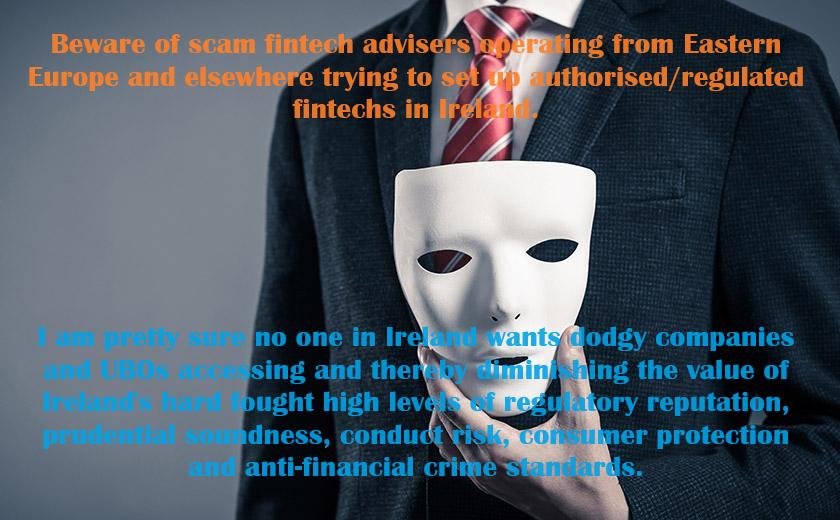
I am pretty sure that no one in Ireland wants dodgy companies and UBOs accesses and thereby diminishing the value of Ireland's hard fought high levels of regulatory reputation, prudential soundness, conduct risk, consumer protection and anti-financial crime standards.

I am pretty sure that my peers in other EU Member States feel the same way.
0 Comments

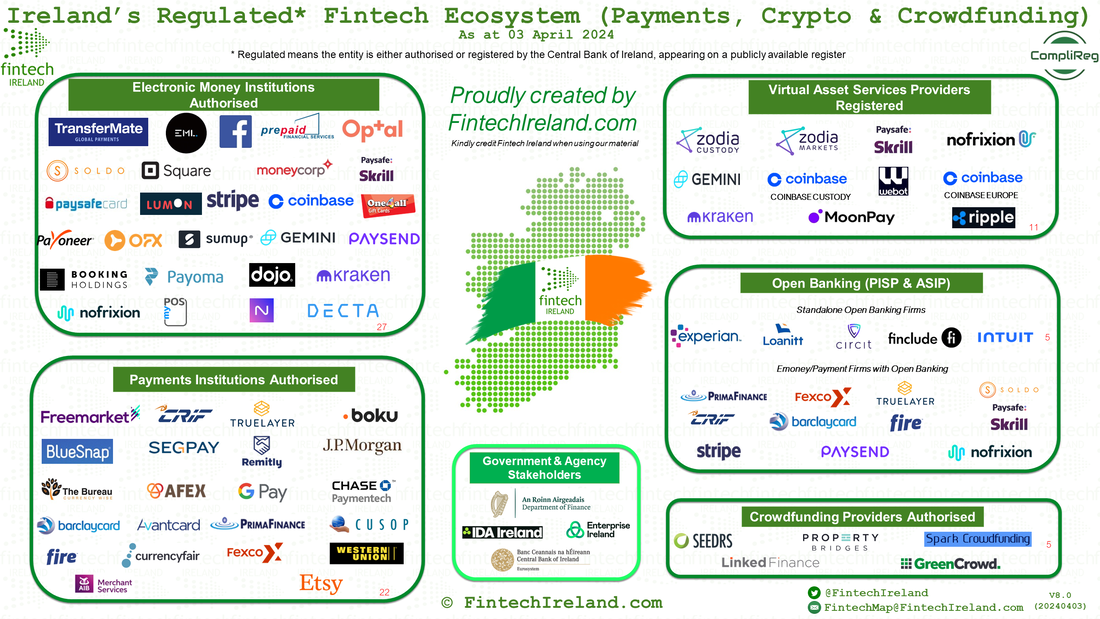
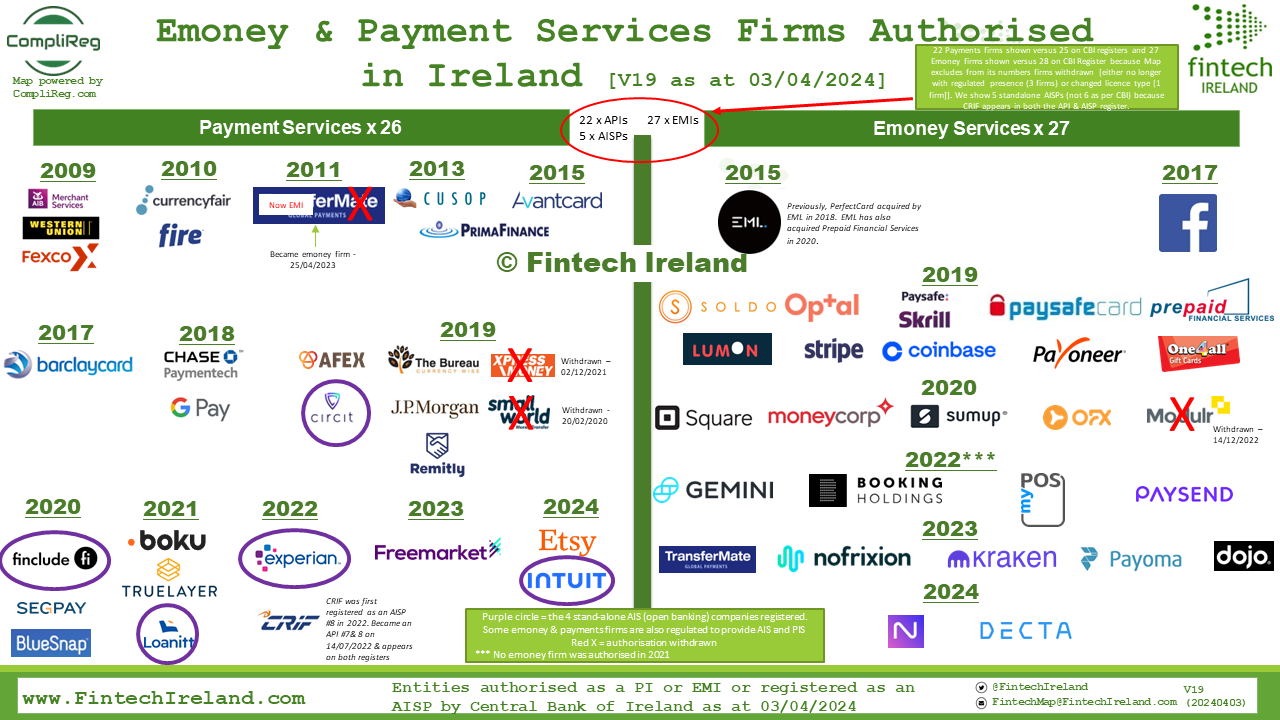
Intuit Ireland Software obtains an open banking registration in Ireland.  Version 8 and 19 of Regulated Fintech Maps released showcasing 69 regulated fintechs.

3/4/2024

0 Comments

 
Picture
Picture
Click for a larger image
​Sign up to our Newsletter here.​
  • Need assistance with an emoney or payments authorisation or an account information service provider or virtual asset services provider registration application, check out Fintech Ireland and CompliReg's handy authorisation guides at https://fintechireland.com/fintech-authorisations.html.  
LinkedIN Post here - https://www.linkedin.com/posts/peteroakes_fintech-electronicmoney-paymentservices-activity-7181459570395877376-2pN3
​Welcome Intuit Ireland Software Limited to the regulated fintech ecosytem in Ireland!  Its authorisation brings the pool of regulated fintech in Ireland to 69, comprised of:
​
  • 27 authorised electronic money institutions
  • 21 payments institutions,
  • 5 standalone open banking firms
  • 11 virtual asset services providers and
  • 5 crowdfunding services providers. 
​Intuit Ireland Software Limited registration is the 1st standalone open banking firm to be registered in Ireland since July 2022. 

The company was incorporated in Ireland just under one year ago on 6 April 2023. and was registered by the Central Bank of Ireland on 2 April 2024.

Ireland now has 16 entities which are authorised or registered to provide open banking services.  These include 5 standalone entities and a mix of 11 emoney and payment firms which can provide such services. 

As we said back on 20 February 2024, we are pretty sure that these numbers will continue to grow in 2024.

Intuit Ireland Software Limited  has been registered by the Central Bank of Ireland to provide payment services #8 (Account information services) ​
Picture
​Intuit Ireland Software Limited is owned 1005 by Intuit Inc.
LinkedIN Post here - https://www.linkedin.com/posts/peteroakes_fintech-electronicmoney-paymentservices-activity-7181459570395877376-2pN3
​
  • Sign up to our Newsletter here.
  • Need assistance with an emoney or payments authorisation or an account information service provider or virtual asset services provider registration application, check out Fintech Ireland and CompliReg's handy authorisation guides at https://fintechireland.com/fintech-authorisations.html.  
0 Comments

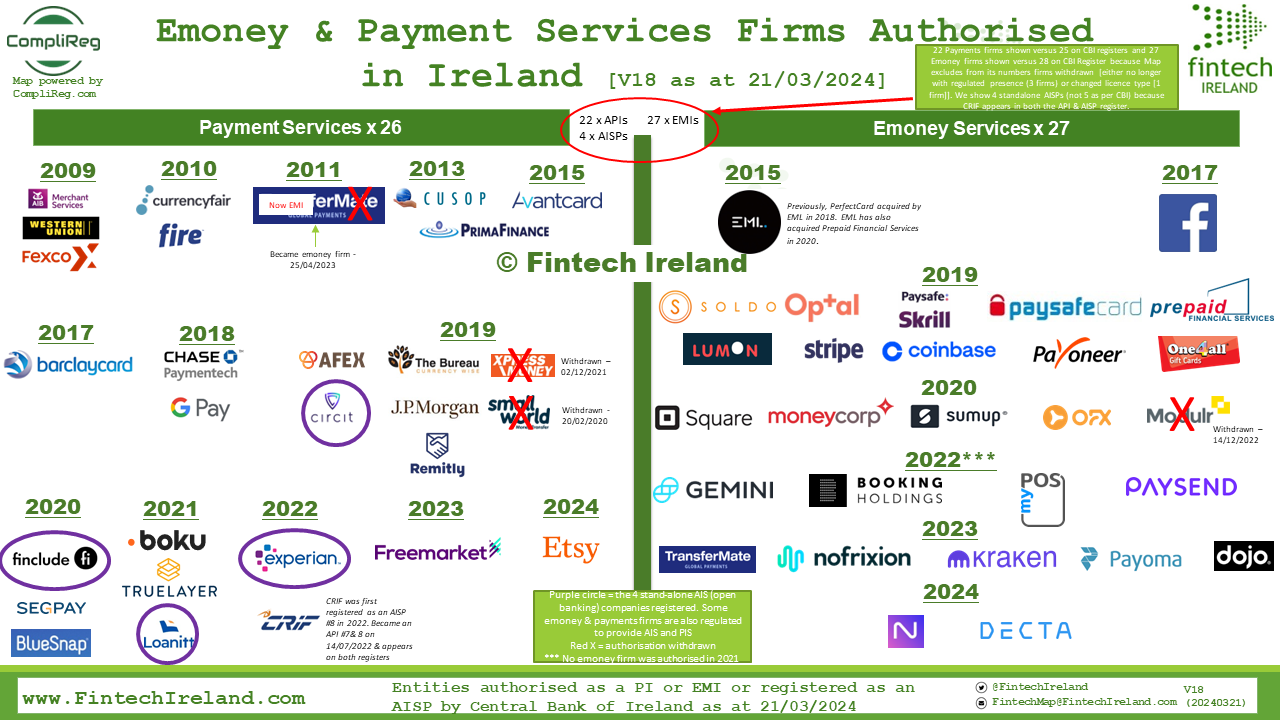
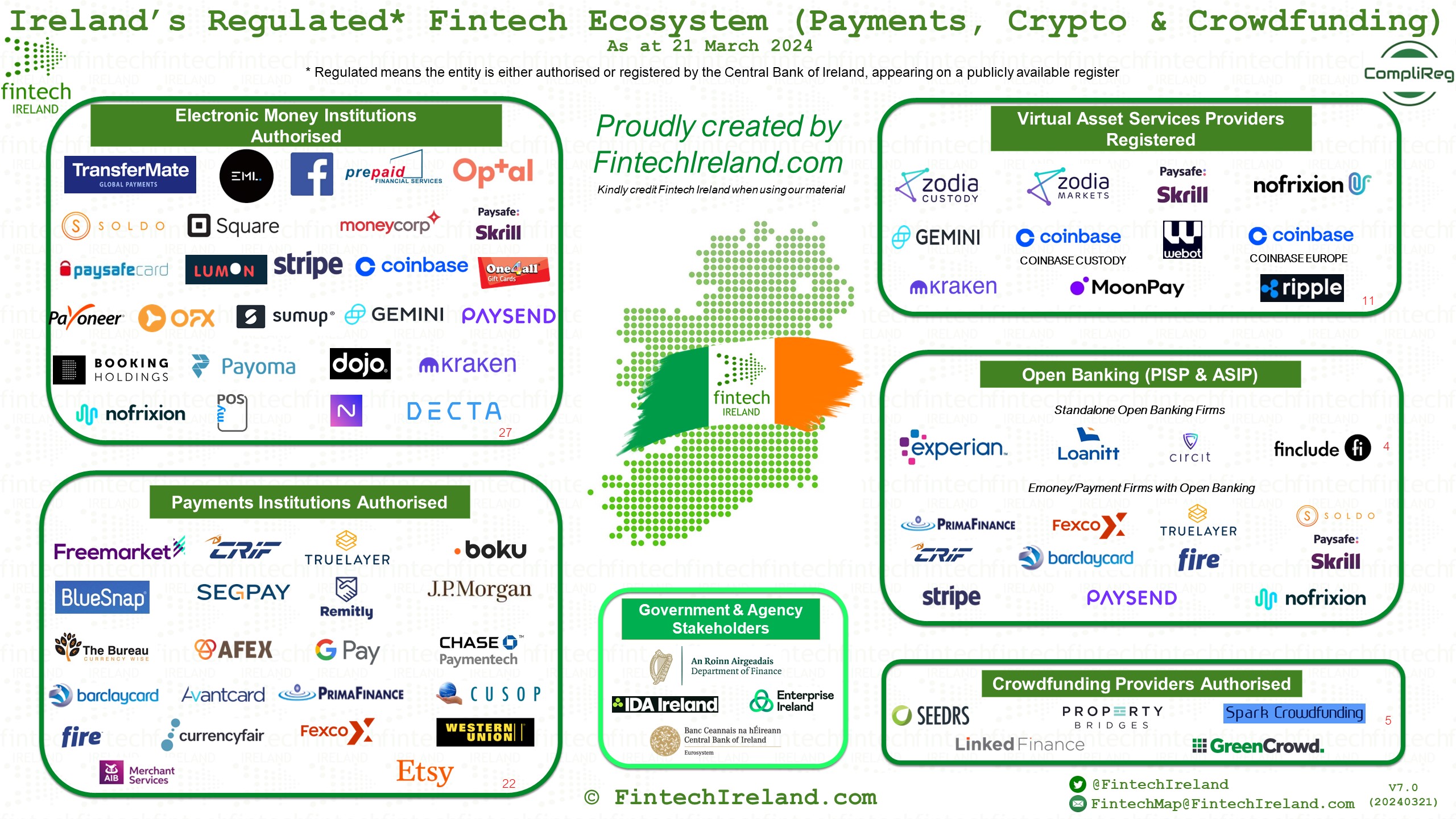
Decta obtains an emoney authorisation in Ireland.  Version 7 and 18 of Regulated Fintech Maps released showcasing 68 regulated fintechs

21/3/2024

0 Comments

 
Picture
Click for larger image
Picture
Click for larger image
  • Sign up to our Newsletter here.
  • Need assistance with an emoney or payments authorisation or an account information service provider or virtual asset services provider registration application, check out Fintech Ireland and CompliReg's handy authorisation guides at https://fintechireland.com/fintech-authorisations.html.  
LinkedIN Post here - https://www.linkedin.com/posts/peteroakes_fintech-electronicmoney-paymentservices-activity-7176891077675626497-X-ZI

Welcome Decta Limited to the regulated fintech ecosytem in Ireland!  Its authorisation brings the pool of regulated fintech in Ireland to 68, comprised of:
  • 27 authorised electronic money institutions
  • 21 payments institutions,
  • 4 standalone open banking firms
  • 11 virtual asset services providers and
  • 5 crowdfunding services providers. 
Decta Limited's authorisation is the 2nd emoney institution to be authorised so far this year. The most recent payments company authorised was Etsy Ireland Limited and previous to that it was emoney firm Navro Payments Europe Limited.

As we said back on 20 February 2024, we are pretty sure that these numbers will continue to grow in 2024.

In what must have felt as extended St Patrick Day's long weekend for the Irish Decta Team, the company was authorised by the Central Bank of Ireland on Tuesday 19 March 2024 as an emoney institution. 
Decta Ireland has been authorised to provide emoney services and payment services #3c (Execution of credit transfers, including standing orders) and #5 (Issuing of payment instruments and/or acquiring of payment transactions).
Picture
Decta Limited has been authorised to provide emoney services and payment services #3 (Execution of credit transfers, including standing orders) and #5 (Issuing of payment instruments and/or acquiring of payment transactions). 

Some observations:
  • ​Why did Decta seek an authorisation in Ireland when another Decta Limited became authorised in Cyprus for emoney services on 10 August 2023?
  • The Irish company was incorporated back on 1 October 2021.  That seems a long time from its incorporation date to today for an entity to become authorised - nearly 30 months. While a firm may not start an application immediately after it is incorporated, most firms - where they are the subsidiaries of foreign firms - start the journey no later than three to six months following incorporation.  If one was conservative and went with the six month timeline, it may have taken Decta Limited 24 months to become authorised.    
  • It appointed its first set of Irish resident NEDs on 1 June 2022, with one of them leaving just after Christmas Day 2023 following the appointment of another NED just before that Christmas period.
  • In addition to the NEDs, the company's local CEO sits on its board together with two group executives including its Cypriot authorised company's CEO and its Deputy CEO. 
  • The Irish comapny's shareholders are RRE Tradecenters Holding Limited based in Cyprus and SIA "Suharenko Family Investments" based in Latvia, holding 67% and 33% of the Irish company respectively.   
  • SIA "Suharenko Family Investments" is a shareholder in the Latvia Bank, AS “Rietumu Banka”.  
  • Irish billionaire Dermot Desmond owns a one-third stake in Rietumu Banka.  Its group profits fell 37pc to €11.4m in the first nine months of 2023.
  • Decta's operations in the UK, Decta Limited (UK), are authorised by the Financial Conduct Authority for emoney and payment services. 
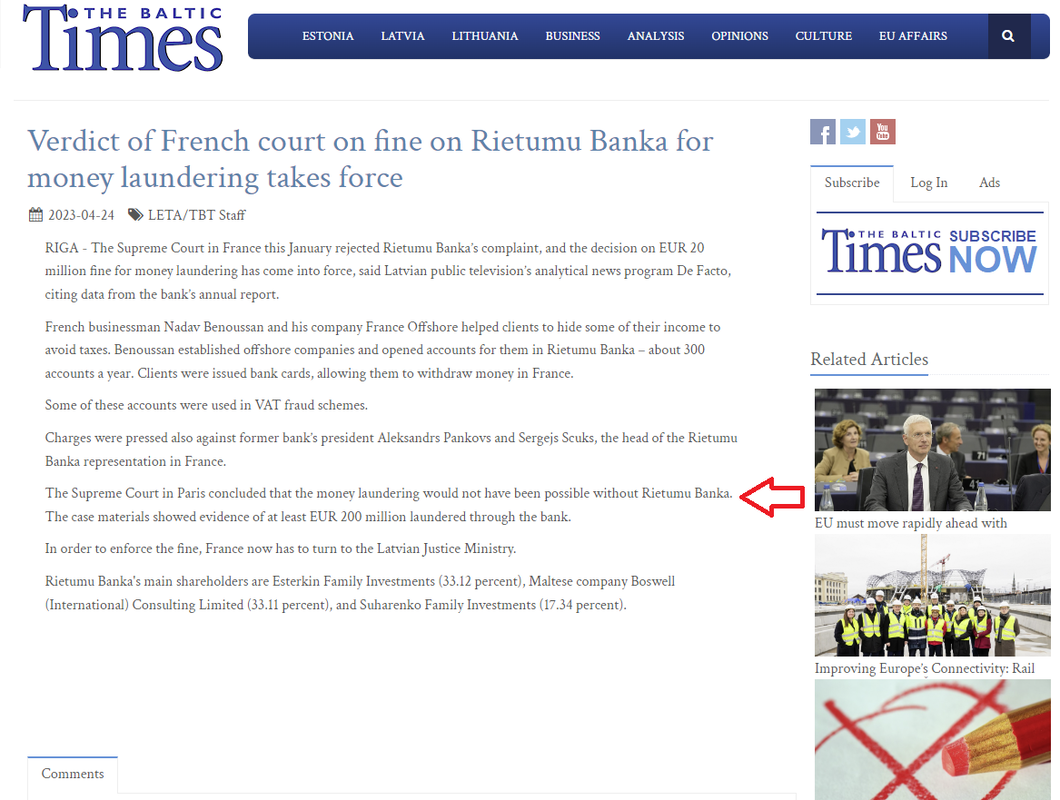
  • Decta was cited by Transparency International UK in a report focused upon financial crime risk.  The very informative report titled 'Together in Electric Schemes, Analysing Money Laundering Risk in E-Payments' was issued in December 2021.  The Bank was hit by two regulatory sanctions.  The largest sanction was a fine of €80mn later reduced by a French appeals court to €20mn.  According to The Baltics Times on 24 April 2023 "The Supreme Court in Paris concluded that the money laundering would not have been possible without Rietumu Banka. The case materials showed evidence of at least EUR 200 million laundered through the bank."  
  • According to CRO records for Decta Limited as at year end December 2022 the company incurred a loss of €114.1K, had Net Current Assets of €46.9K and Net Liabilities of €110.6K.
The Decta brand was called out by Transparency International UK in a report focused upon financial crime risk.
Picture
​The Decta brand was called out by Transparency International UK in a report focused upon financial crime risk.  The very informative report titled 'Together in Electric Schemes, Analysing Money Laundering Risk in E-Payments' and issued in December 2021 carried a case study in which it noted that:

"[s]ome Latvian banks now own UK EMIs. Decta Limited, a UK EMI, lists its PSC as Rietumu Holding, the firm behind Rietumu Bank in Latvia.  In 2017, Rietumu was fined €80 million by French authorities after it was found to be involved in major tax and money laundering schemes. In response to an investigation by independent global media organisation, openDemocracy, Decta Limited stated it “acts in strict accordance with the requirements of FCA”, adding “we regularly pass anti-money-laundering (AML), Anti-Fraud, Know Your Customer and Combating the Financing of Terrorism audits held by Visa, Mastercard and big-four auditors, proving Decta to be complying with all latest AML standards.” 

In June 2021, Rietumu was fined again for money laundering failings in Latvia, this time in relation to its association with payment service providers, including those based outside of the country. A page on the website of Latvia’s central bank (Latvijas Banka), shows Rietumu has correspondent banking relationships with at least six UK EMIs.

It is becoming increasingly clear that British EMIs using Baltic banks for clearing services raises money laundering risk for both the UK and Baltic states. UK EMIs with unsuitable owners or weak AML controls are unlikely to carry out sufficient checks on their clients, while Baltic banks may believe firms regulated by the FCA have higher AML standards than they do in reality. This situation would lead to international payments being made from British EMI accounts using Baltic correspondent banks without sufficient checks being carried out on who was making them. This is similar to the scenario that occurred in the “Laundromats” exposed by the OCCRP, which resulted in billions of pounds in suspicious transactions being sent around the world." (see page 15 of this document).

Read more media here:


19/04/2022 - Last year also saw an appeals court in Paris reduce to €20 million a previous €80 million fine levied by a French court in 2017 against the bank for allegedly enabling clients of a company called France Offshore to evade taxes and launder money through companies in tax havens.

24/04/2023 - Verdict of French court on fine on Rietumu Banka for money laundering takes force
  • decision on EUR 20 million fine for money laundering has come into force

17/06/2021 - Latvian bank Rietumu fined 5.85 mln for money laundering failures 
LinkedIN Post here - https://www.linkedin.com/posts/peteroakes_fintech-electronicmoney-paymentservices-activity-7176891077675626497-X-ZI
​
  • Sign up to our Newsletter here.
  • Need assistance with an emoney or payments authorisation or an account information service provider or virtual asset services provider registration application, check out Fintech Ireland and CompliReg's handy authorisation guides at https://fintechireland.com/fintech-authorisations.html.  
0 Comments

20240308 - Update to Ireland for Finance: Spotlight on Sustainable Finance

8/3/2024

0 Comments

 
To stay abreast of developments at FintechHub.ie sign up to our Newsletter HERE
Of the 13 measures detailed in Action Plan 2024, item 3 is about ​"Assess the proposal for the establishment of a national fintech hub" 
Picture
Dr. Jennifer Carroll MacNeill TD Minister of State with responsibility for Financial Services, Credit Unions and Insurance
Picture
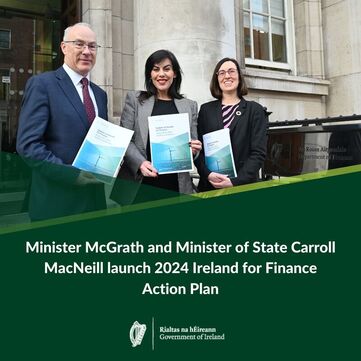
The Minister for Finance, Michael McGrath TD, and Minister of State for Financial Services, Credit Unions, and Insurance, Jennifer Carroll MacNeill TD, have launched the second Action Plan from the updated Ireland for Finance strategy following Cabinet approval.
To stay abreast of developments at FintechHub.ie sign up to our Newsletter HERE
Minister McGrath and Minister of State Carroll MacNeill launch 2024 Ireland for Finance Action Plan
From Department of Finance 
Published on 8 March 2024
Last updated on 8 March 2024
 
The Minister for Finance Michael McGrath and Minister of State for Financial Services, Credit Unions, and Insurance Dr Jennifer Carroll MacNeill today (Friday 8 March) launch the second Action Plan from the updated Ireland for Finance strategy following Cabinet approval.

The updated Ireland for Finance strategy looks to further establish Ireland as the recognised global location of choice for specialist international financial services. The 2024 Action Plan details various key measures to realise this ambition over the course of this year, in collaboration with both public and private sector stakeholders. There is an estimated 57,600 people now directly employed in the international financial services sector, with the industry also indirectly supporting a range of professional areas. Following on from the update to the strategy in October 2022, the new Action Plan is focused on 13 key deliverables over the remainder of the year under the five themes, namely:

• Sustainable finance
• Fintech and Digital finance
• Diversity and Talent
• Regionalisation and Promotion
• Operating Environment

This plan contains a special edition on sustainable finance.

These 13 measures are in addition to the continued work that is carried out by organisations in the public and private sectors that allow Ireland to be the location of choice for international financial services firms.
Picture
Commenting on the launch, Minister McGrath noted:
“It is my great pleasure, in partnership with my colleague Minister of State Carroll MacNeill, to launch the Action Plan 2024 under the Update to the Ireland for Finance Strategy. This plan, developed by the Department of Finance in conjunction with private and public sector partners, clearly outlines our focus for the coming year. This includes the continued development of Ireland as a centre for sustainable finance and fintech, development of the required skills for careers in the financial services industry, and promotion of and support for companies operating in the sector. With this activity, we will further establish Ireland as a premier financial centre in Europe and a location of choice for specialist international financial services.”

Minister Carroll MacNeill said:
“We are at a pivotal moment for the next step of international financial services in Ireland as the twin powerhouses of fintech and sustainable finance look to change the course of investment and delivery of financial services products over the coming years.

The sector continues to contribute positively to our economy and society since the establishment of the Irish Financial Services Centre some four decades ago.

Action Plan 2024 under the updated Ireland for Finance Strategy sets out how the Irish Government and industry continue in partnership to enhance the environment for financial services firms in Ireland, and to improve our competitiveness as an attractive location for innovation and for international business.”


The update to Ireland for Finance Action Plan 2024 was launched by Minister McGrath and Minister of State Carroll MacNeill ahead of their respective participation in the St Patrick’s Day Programme, where Minister McGrath will visit China while Minister of State Carroll MacNeill travels to Miami, Costa Rica and Mexico.


Notes to editors
The update to Ireland for Finance utilises a whole-of-government approach which is supported through ongoing collaboration between public and private stakeholders and educational institutions to ensure the talent and expertise of all three sectors can continue to be successfully harnessed to build on existing achievements and secure the ambitions set out in Ireland for Finance.

The Strategy is updated each year by means of annual Action Plans. This approach ensures that the Strategy remains relevant and up-to-date in identifying and addressing emerging challenges. Each annual Action Plan contains a list of measures grouped under five themes be actioned in that year with a responsible stakeholder tasked with leading on the execution of each measure.

The implementation of the Strategy is overseen by a public sector High Level Implementation Committee (HLIC) with assistance from an Industry Advisory Committee (IAC). This Joint Committee meets quarterly and it is chaired by Minister of State Carroll MacNeill. The Minister of State is supported by the International Financial Services Unit in the Department of Finance. The HLIC membership consists of senior officials of the Departments of the Taoiseach; Further and Higher Education, Research, Innovation and Science; Foreign Affairs; Enterprise, Trade and Employment; and Finance and the Chief Executive Officers of the IDA and Enterprise Ireland. The IAC includes key industry stakeholders such as representative bodies (secretariat), advisory firms and senior executives from companies across the different international financial services sectors.

There are 13 measures detailed in Action Plan 2024, with the lead organisation noted against each below. These will be achieved through collaboration with relevant stakeholders.
​
  1. Implement the updated Sustainable Finance Roadmap – International Sustainable Finance Centre of Excellence
  2. Promote Ireland’s Evolving Sustainability Value Proposition – IDA Ireland
  3. Assess the proposal for the establishment of a national fintech hub – Department of Enterprise, Trade and Employment and the Department of Finance
  4. Enhanced supports for ambitious early stage fintech innovators expanding into their first international market – Enterprise Ireland
  5. Support Innovative Fintech and Digital Finance Investments across the IFS Portfolio - IDA
  6. Ireland South East Financial Services Cluster REISS Project – Feasibility study - South East Financial Services Cluster (SEFSC)
  7. Continue funding towards internationalisation and scaling of Irish fintechs - Enterprise Ireland
  8. Irish fintech and financial services companies achieving competitive advantage through innovation and digitisation – Enterprise Ireland
  9. Establish an Expert Group on Future Skills Needs (EGFSN) national oversight and implementation group – EGFSN secretariat supporting the rotating chair
  10. Promote regionalisation for international financial services investments – Enterprise Agencies
  11. Team Ireland will support client participation in 2024 international fintech events – Enterprise Agencies
  12. Review the Central Bank of Ireland’s approach to innovation engagement in financial services – Central Bank of Ireland
  13. Covered bonds environment in Ireland – Department of Finance
0 Comments
<<Previous
Forward>>

    Author

    Fintech Ireland

    Archives

    December 2026
    May 2026
    March 2026
    December 2025
    October 2025
    September 2025
    July 2025
    March 2025
    February 2025
    January 2025
    December 2024
    November 2024
    October 2024
    July 2024
    June 2024
    May 2024
    April 2024
    March 2024
    February 2024
    December 2023
    November 2023
    October 2023
    September 2023
    August 2023
    July 2023
    June 2023
    May 2023
    April 2023
    February 2023
    October 2022
    July 2022
    June 2022
    April 2022
    March 2022
    January 2022
    December 2021
    July 2021
    May 2021
    April 2021
    March 2021
    February 2021
    January 2021
    November 2020
    October 2020
    September 2020
    August 2020
    July 2020
    April 2020
    February 2020
    July 2019
    April 2019
    March 2019
    February 2019
    January 2019
    October 2018
    September 2018
    July 2018
    June 2018
    May 2018
    April 2018
    March 2018
    January 2018
    October 2017
    September 2017
    August 2017
    July 2017
    June 2017
    May 2017
    March 2017
    January 2017
    December 2016
    November 2016
    September 2016
    August 2016
    July 2016
    June 2016
    May 2016
    April 2016
    March 2016
    February 2016
    December 2015
    September 2015
    July 2015
    June 2015
    May 2015
    April 2015
    March 2015
    September 2014
    January 2014

    Categories

    All
    Account Information Services
    AISP
    Anne Boden
    Authorisations
    #bankinginquiry
    Bank Of England
    Bitcoin
    Brian Fahey
    British Embassy Dublin
    Business Post
    CB Insights
    Central Bank Of Ireland
    Challenger Bank
    Chambers And Partners
    Competition And Consumer Protection Commission
    Compliance
    Consultations
    Contributor Articles
    Corporate Governance
    Crowdingfunding
    Crypto Assets
    Cryptocurrencies
    Currency Fair
    Cyber Security
    DeFi
    Department Of Finance
    Digital Assets
    Digital Euro
    Digital Wallets
    Directors Duties
    Disruption
    Dogpatch Labs
    Electronic Money
    EML Payments
    EMoney
    European Commission
    Financial Literacy
    Fintech
    Fintech Abu Dhabi
    Fintech Hub
    Fintech Ireland
    Fintech Ireland Map
    Fintech Ireland Summit
    Fintech Leaders Series
    Funding
    Funds
    Gemini
    Ifs2020
    Ifsc
    Innovation
    International Financial Services Strategy
    Ireland For Finance
    Irish Fintech Companies
    John Berrigan
    Kraken
    Mairead McGuiness
    Marketplace
    MiCA
    Mifid
    Moneycorp
    Money Laundering
    Monzo Bank
    MoonPay
    MyComplianceOffice
    Neobanks
    Newsletter
    Nuapay
    @oakeslaw
    OFX Payments
    Paschal Donohue
    Payments
    Payments Institution
    Paysafe
    Payward
    Peer To Peer
    Peer-to-peer
    Realex Payments
    Regtech
    Regulated Fintech
    Regulation
    Roboadvisers
    Robo Advisors
    Robo-advisors
    Ronan Gallagher
    RTE
    Sandbox
    Sentenial
    Simon Harris
    Square
    SquareUp International
    Stablecoins
    Starling Bank
    Strategy
    SYNC Payments
    The Project Foundry
    TransferMate
    Unicorn
    Unicorns
    USA Today
    Virtual Assets
    Wealthtech
    Zodia Custody
    Zodia Markets

©Fintech Ireland and ©Fintech.  Fintech Ireland (523657) and Fintech (523656) are registered with the Companies Registration Office in Ireland
www.fintechireland.com / www.fintechireland.ie / www.irishfintech.ie / www.irishfintech.com / www.fintechcareers.ie
Privacy Policy