fintech IRELAND
email / social
  • Home
  • Fintech Authorisations
  • Fintech Education & Training
  • Fintech Ireland Map
    • Fintech Survey
  • Events
    • Summit
    • Events-Archive
  • Fintech Hub
  • News-Insights
    • Consultations
    • News Page Back Up
  • Careers
  • RegTech
  • CRYPTO
  • Fundraising
  • Brexit & Ireland
  • About
    • Fintech Family Network
  • Get Involved

Virtual Asset Service Provider applicants told to improve the quality of their applications and  AML/CFT frameworks and knowledge by the Central Bank of Ireland CLICK HERE

11/7/2022

0 Comments

 
Picture
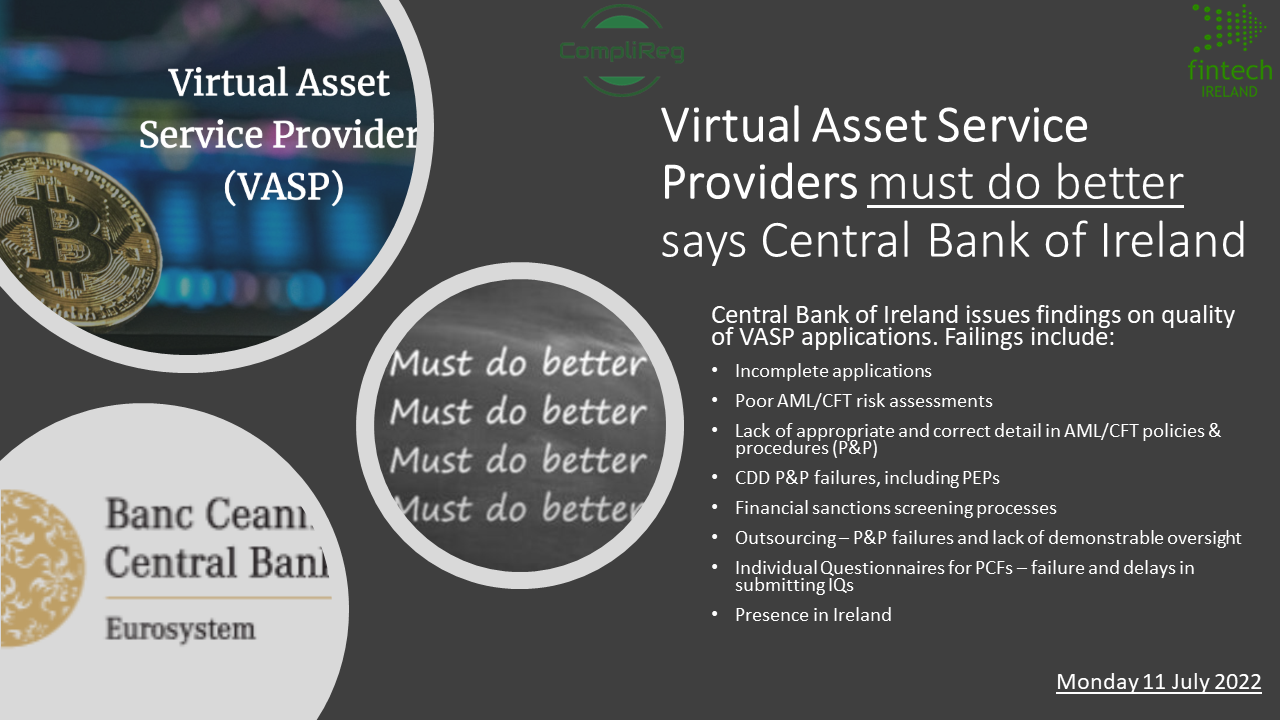
Today (Monday 11 July 2022) the Central Bank of Ireland issued a press release highlighting weaknesses in Virtual Asset Service Providers’ (VASP) AML/CFT Frameworks.

Accompanying today's press release is 
a bulletin in relation to VASPs, seeking to assist applicant firms to strengthen both their applications for registration and their Anti-Money Laundering and Countering the Financing of Terrorism (AML/CFT) Frameworks.

The Central Bank says 
while it seeks to anticipate and support innovation in the financial services industry, firms operating in novel areas must ensure their businesses will not be used to launder the proceeds of crime or to finance terrorism.  The Central Bank issued the bulletin to VASPs to assist them in strengthening their applications and frameworks.

Read more here, including an analysis by CompliReg.
0 Comments

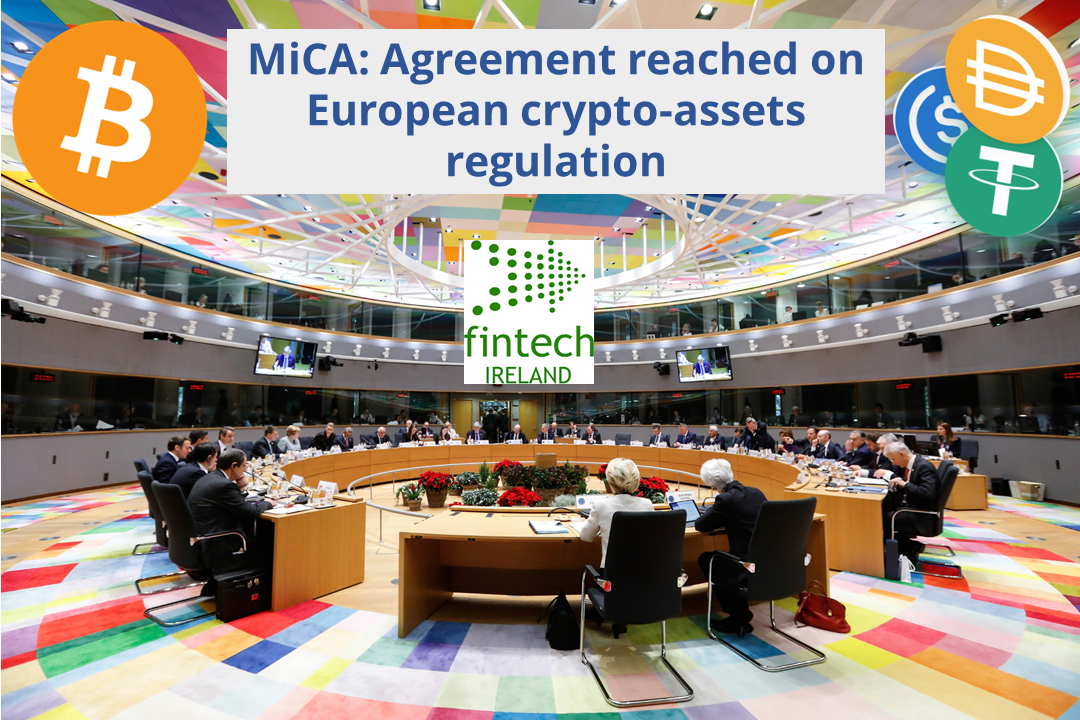
Agreement Reached on European Crypto-Assets Regulation (MiCA)

30/6/2022

0 Comments

 
Picture

Agreement Reached on European crypto-assets regulation (MiCA)
​

Sinn Féin MEP Chris MacManus

By Peter Oakes, Founder of Fintech Ireland
Don't forget to subscribe to our Newsletter and visit our Crypto & Digital Asset page for information.
 
Background:
  • MiCA is part of the larger digital finance package, which contains a digital finance strategy, a Digital Operational Resilience Act (DORA) – that will cover CASPs - and a proposal on distributed ledger technology (DLT) pilot regime for wholesale uses.
  • MiCA is intended to bridge a gap in existing EU legislation:
    • ensuring that the current legal framework does not pose obstacles to the use of new digital financial instruments.
    • ensuring that such new technologies and products fall within the scope of financial regulation and operational risk management arrangements of firms active in the EU.
    • ensuring the supporting of innovation and uptake of new financial technologies.
    • providing an appropriate level of consumer and investor protection.

Key provisions agreed by European Union Parliament negotiators for those issuing and trading crypto-assets (including asset-reference tokens and e-money tokens) cover transparency, disclosure, authorisation and supervision of transactions. Consumers would be better informed about risks, costs and charges. In addition, the new legal framework will support market integrity and financial stability by regulating public offers of crypto-assets. Finally, the agreed text includes measures against market manipulation and preventing money laundering, terrorist financing and other criminal activities.

Timeline:
  • 24 September 2020: European Commission came forward with the MiCA proposal
  • 24 November 2021: The Council adopted its negotiating mandate on MiCA
  • 31 March 2022: Trilogues between the co-legislators commenced
  • 30 June 2022: Provisional agreement reached.
  • Next Steps: The Provisional agreement must now be approved first by the Economic and Monetary Affairs Committee  followed by a plenary vote of the European Union Parliament and the Council of the European Union Council also has to approve the deal, before the MiCA Regulation can come into force.
  • Early 2024: It is expected that MiCA should be implemented by early 2024.
 
What:
  • The EU brings crypto-assets, crypto-assets issuers and crypto-asset service providers to come under a single EU regulatory framework for the first time.
  • On Thursday, 30 June 2022, the Economic and Monetary Affairs Committee negotiators for the European Parliament struck a provisional political agreement with the European Union Council on new rules on crypto-assets. 
Scope:
  • issuers of unbacked crypto-assets (this means that Central Bank Digital Currencies are not in scope),
  • stablecoins
  • trading venues where crypto-assets are held
  • wallets where crypto-assets are held.
  • non-fungible tokens (NFTs) i. e. digital assets representing real objects like art, music and videos, are excluded from MiCA except if they fall under existing crypto-asset categories.
Why:
  • Regulatory Framework: MiCA designed to protect investors and preserve financial stability.
  • Legal Certainty: Pan-EU wide definitions, legal provisions and authorisation standards not only serve the Regulatory Framework, but provide enhanced legal certainty for issuers, holders, users, regulators and government agencies.
  • Innovation: MiCA designed to provide for innovation and fostering attractiveness of the EU crypto-asset sector.
  • Uniformity: MiCA designed to bring more clarity (and hopefully remove any possible regulatory arbitrage going forward) and uniformity of approach to crypto assets in the EU.  Particularly important as some member states have national legislation for crypto-assets but without a specific regulatory framework at EU level, the EU risk fragmentation and arbitrage.
  • Consumer & Investor Protection: An urgent need for an EU-wide regulation has arisen because of recent developments (such as the crypto-crash / ‘crypto winter’).  MiCA aims to better protect Europeans who have invested in crypto-assets and prevent their misuse. Like all regulations, MiCA will protect consumers against some, but not all, of the risks associated with investing and help them avoid fraudulent schemes.
  • Reputation: MiCA aims at putting to an end to the crypto wild west.
  • Standard Setting: MiCA will confirm the EU’s role as a standard-setter for digital asset innovation in a pan-EU regulatory environment.

Consumer Protection:
  • Currently, consumers have very limited rights to protection or redress, especially if the transactions take place outside the EU. With the new rules, crypto-asset service providers will have to respect strong requirements to protect consumers wallets and become liable in case they lose investors’ crypto-assets. MiCA will also cover any type of market abuse related to any type of transaction or service, notably for market manipulation and insider dealing.

ESG:
  • Actors in the crypto-assets market will be required to declare information on their environmental and climate footprint. The European Securities and Markets Authority (ESMA) will develop draft regulatory technical standards on the content, methodologies and presentation of information related to principal adverse environmental and climate-related impact. Within two years, the European Commission will have to provide a report on the environmental impact of crypto-assets and the introduction of mandatory minimum sustainability standards for consensus mechanisms, including the proof-of-work.

Financial Crime:
  • Crypto-assets will be covered by EU updated anti-money laundering (AML), legislation.  MiCA will not duplicate the anti-money laundering provisions as set out in the newly updated transfer of funds rules agreed on 29 June 2022. 
  • This means that the ‘travel rule’.i.e. the rules on information accompanying the transfers of funds will be extended to transfers of crypto assets.  The EU is adamant about meeting the international standards on the exchange of crypto-assets, in particular recommendations 15 and 16 of the Financial Action Task Force (FATF), the global money laundering and terrorist financing watchdog.  Read the FATF’s release on 29 June 2022 ‘Targeted Update on Implementation of FATF’s Standards on VAs and VASPs.’ For further information.
  • The European Banking Authority (EBA) will be tasked with maintaining a public register of non-compliant crypto-asset service providers.
  • Crypto-asset service providers (CASPs), whose parent company is located in countries listed on the EU list of third countries considered at high risk for anti-money laundering activities, as well as on the EU list of non-cooperative jurisdictions for tax purposes, will be required to implement enhanced checks in line with the EU AML framework.
  • Tougher requirements may also be applied to shareholders and to the management of the CASPs), notably with regard to their localisation.

StableCoins:
  • A strong regulatory framework will apply to stablecoins to protect consumers.  The EU feels that this should be self-evident given the recent crystallising of risks incurred by holders in the absence of regulation, as well as the contagion impact stablecoins have on other crypto-assets.
  • Stablecoins issuers must:
  1. build up a sufficiently liquid reserve
  2. apply a 1/1 ratio and partly in the form of deposits. 
  3. provide every “stablecoin” holder with a claim at any time and free of charge by the issuer
  4. ensure that the rules governing the operation of the reserve provides provide for an adequate minimum liquidity.
  • Stablecoins will be supervised by the EBA, with a presence of the issuer in the EU being a precondition for any issuance.

Asset-Referenced Tokens:
  • Asset-referenced tokens (ARTs) based on a non-European currency used as a means of payment will be constrained to preserve the EU’s monetary sovereignty. Issuers of ARTs will need to have a registered office in the EU to ensure the proper supervision and monitoring of offers to the public of asset-referenced tokens.

Non-Fungible Tokens:
  • Non-fungible tokens (NFTs), i. e. digital assets representing real objects like art, music and videos, are excluded from the scope except if they fall under existing crypto-asset categories. Within 18 months the European Commission will be tasked to prepare a comprehensive assessment and, if deemed necessary, a specific, proportionate and horizontal legislative proposal to create a regime for NFTs and address the emerging risks of such new market.

Regulatory Framework:
  • CASPs will require an authorisation to operate within the EU.
  • Regulators (i.e. national authorities) required to issue authorisations within three months.
  • Regarding the largest CASPs, national authorities will transmit relevant information regularly to the European Securities and Markets Authority (ESMA).

Next steps:
  • The Provisional agreement must now be approved first by the Economic and Monetary Affairs Committee  followed by a plenary vote of the European Union Parliament and the Council of the European Union Council also has to approve the deal, before the MiCA Regulation can come into force. See more here. 
  • It is expected that MiCA should be implemented by early 2024.


Quotes from some of the EU MEPs negotiating the Regulation for the EU Parliament:

Stefan Berger (EPP, DE), the lead MEP for the negotiating team,
  • "MiCA is a European success. We are the first continent to have a crypto-asset regulation. In the Wild West of the crypto-world, MiCA will be a global standard setter. MiCA will ensure a harmonised market, provide legal certainty for crypto-asset issuers, guarantee a level playing field for service providers and ensure high standards for costumer protection. Tokenisation will be as ground breaking for the financial world as the introduction of the joint market was in the 17th century. With the MiCA regulation, reliable authorisation and supervisory structures for new tokens are now being created for the first time."

Chris MacManus (Sinn Féin, IE) MEP on the negotiating team:
  •  “I am pleased to see this deal hammered out. The way is now clear for this regulation of the crypto world, or the “wild west” as Fabio Panetta of the ECB described it, to be subject to a level of transparency and regulation. This has been sorely lacking and has left consumers vulnerable when dabbling in crypto-assets especially in the trading of crypto currencies.”
  • “MiCA also compels companies trading in crypto-assets to disclose the environmental impact of the processes behind the creation of that crypto-asset. As we know, some of these use very environmentally wasteful processes. The deal hammered out here is unfortunately weaker than what I sought and weaker than what was originally agreed by the EU Parliament in this important area but it still represents progress in making sure crypto-assets are monitored to check their environmental impact.”


Further reading:
  • 30 June 2022: Cryptocurrencies in the EU: deal struck between Parliament and Council  
  • 30 June 2022 Digital finance: agreement reached on European crypto-assets regulation (MiCA)
  • 29 June 2022 Anti-money laundering: Provisional agreement reached on transparency of crypto asset transfers
  • 29 June 2022 Targeted Update on Implementation of FATF’s Standards on VAs and VASPs
  • 24 November 2021 Digital finance package: Council reaches agreement on MiCA and DORA
  • 24 November 2020 Commission proposal for a Regulation on Markets in Crypto-assets
  • Digital finance (background information)
0 Comments

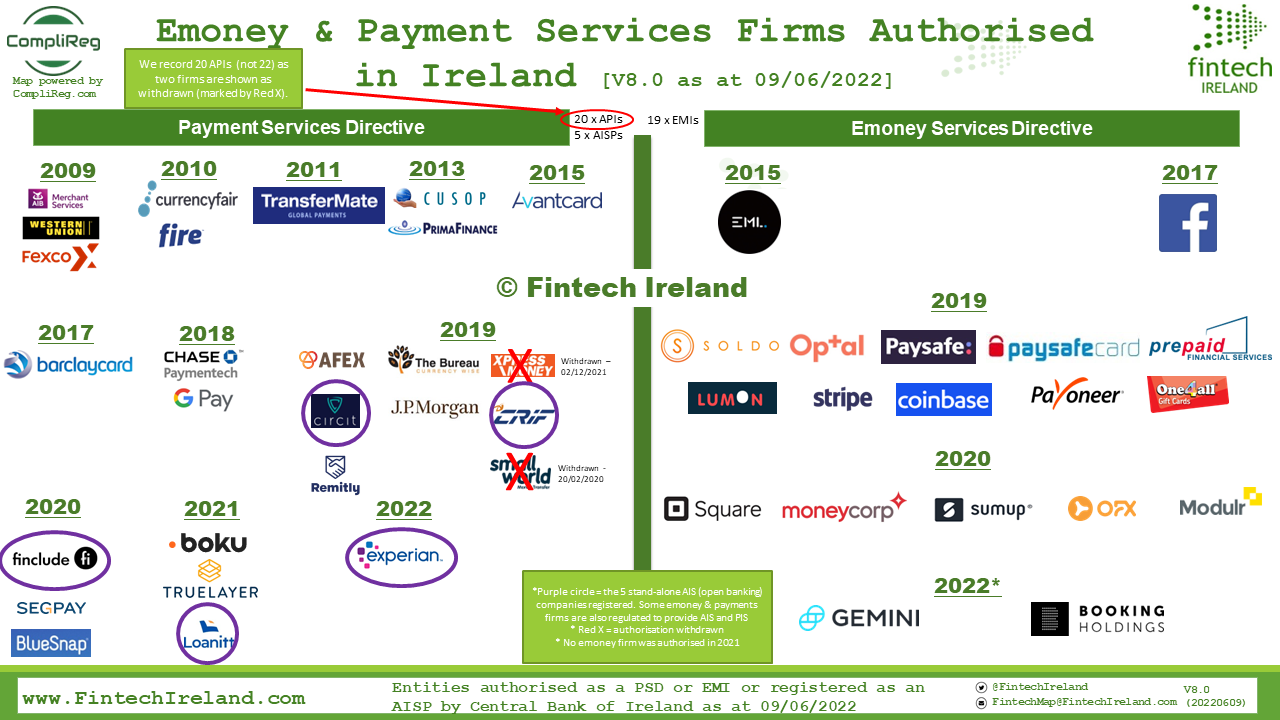
Experian Ireland registered to provide account information services (and updated Regulated Fintech Map v8.0)

9/6/2022

0 Comments

 
Picture
Click for larger image
If you need assistance with an emoney or payments authorisation or an account information service provider registration application, check out Fintech Ireland and CompliReg's handy authorisation guides at https://fintechireland.com/fintech-authorisations.html.
On 9 June 2022 the Central Bank of Ireland registered Experian Ireland Limited as an account information services provider (AISP). Experian Ireland becomes the 5th standalone account information services provider joining Circit Limited (registered 25 February 2019), CRIF RealTime Ireland Limited (registered 30 May 2019), Verge Capital Limited (registered 9 March 2020) and LoanITT Limited (registered 5 November 2021).

Thus far in 2022, the Central Bank of Ireland has only authorised two emoney firms and registered one AISP.  So far no payment services firm has been authorised in Ireland in 2022 as we enter the second half of the year.

Experian Ireland was incorporated in Ireland since 1997. According to CRO filings, the company's turnover for the year ended March 2021 was € 3.71mn up from €5.4mn, recording a loss of €111,000 against a profit in the previous year of $1.34mn.

The register reflects that as at 30 June 2022, the doesn't presently passport services across the European Union. 

As at 30 June 2022, Ireland is now home to 19 authorised electronic money institutions, 20 authorised payment institutions and 5 standalone account information service providers. We have updated our regulated fintech Map to version 8.0 where we showcase these firms.

Our Peter Oakes spoke with Charlie Taylor of the Business Post on Sunday 3 July 2022 about the registration of Experian Ireland as an AISP:
  • "The news was also welcomed by Peter Oakes, a former Central Bank enforcement director and founder of Fintech Ireland, an industry group."Irish customers will be able to share transactional information from their bank account with other banks and third parties. Customers will be able to better monitor, control and improve the way their banking data is used, including managing their so-called ‘credit score’ when looking for financing.
  • “We are yet to see the fruits of open banking in Ireland to the same degree as elsewhere. Together with other fintechs providing open banking, Irish consumers and small businesses will enjoy more choice in an increasingly competitive landscape," Oakes said.

Further Reading: See also Charlie Taylor's article on the authorisation of emoney and payment services firms and the issues firms are facing getting authorised in Ireland in his article of 10 April 2022 titled Defensive attitude of Central Bank putting off fintech investors.  And see our News posts of:
  • 25 April 2022 on the announcement of Bookings Holding becoming an authorised emoney firm; and 
  • 10 April 2022 titled Defensive attitude of Central Bank putting off fintech investors.
0 Comments

Booking Holdings authorised to provide e-money and payment services (and updated Regulated Fintech Map v7.0)

25/4/2022

0 Comments

 
Picture
If you need assistance with an emoney or payments authorisation or an account information service provider registration application, check out Fintech Ireland and CompliReg's handy authorisation guides at https://fintechireland.com/fintech-authorisations.html
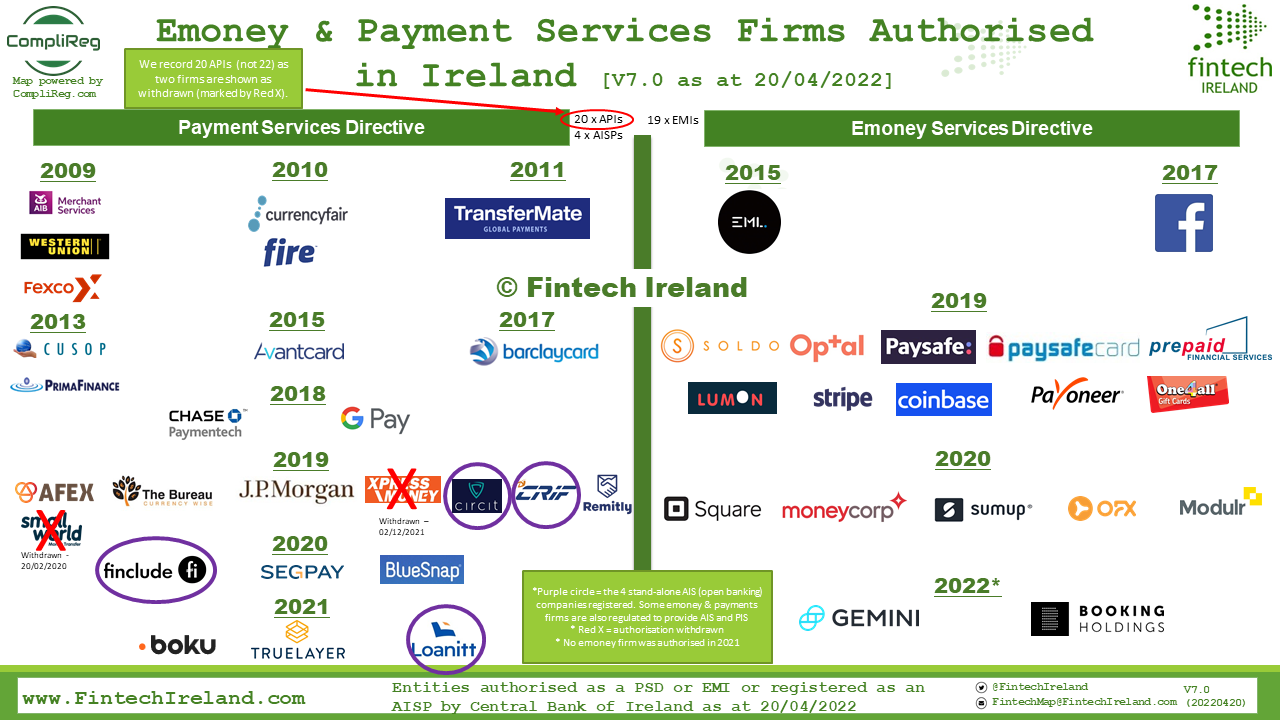
On 20 April 2022 (Central Bank of Ireland run date 21 April 2022), the Irish regulator authorised Booking Holdings Financial Services International Limited as an electronic money institution.  The authorisation comes 21 months following its incorporation on 17 July 2020.

The company, in addition to emoney, is authorised to provide payment services 3b, 3c and 5.  These allow the company to:

*  (3) Execution of payment transactions, including transfers of funds on a payment account with the user’s payment service provider or with another payment service provider:
  • 3 (b) Execution of payment transactions through a payment card or a similar device;
  • 3 (c) Execution of credit transfers, including standing orders
*  5. Issuing of payment instruments and/or acquiring of payment transactions

Ireland is now home to 19 authorised electronic money institutions, 20 authorised payment institutions and 4 standalone account information service providers. We have updated our regulated fintech Map to version 7.0 where we showcase these firms.

Our Peter Oakes spoke with Charlie Taylor of the Sunday Business Post on the authorisation of emoney and payment services firms and the issues firms were facing getting authorised in Ireland.  See Charlie's article of 10 April 2022 titled Defensive attitude of Central Bank putting off fintech investors.


In the article Peter Oakes said:
  • ​Speaking to the Business Post, Peter Oakes, a former Central Bank enforcement director and founder of Fintech Ireland, an industry group, said some companies which had sought authorisation through the Irish regulator had found it difficult to deal with.
  • “The Central Bank is at times coming across as unnecessarily defensive and surprisingly unprepared for meetings with applicants. Wrong or right, this is a situation which has developed and one the regulator is not sufficiently in front of,” he said.
  • Oakes suggested that radical changes were not required to right the current situation.
    “A handful of straightforward enhancements should not only solidify the regulator’s objectives but create a better-informed industry. At the very least it would make clear whether Ireland is a ‘go-to’ effective regulatory jurisdiction for innovation and should prevent the state scoring an own goal by losing out on quality firms moving here because of the current situation,” he said.
    The Central Bank admitted in a statement that authorisation could take time, but said operating a robust authorisation process was “solely aimed at protecting consumers and investors”.

A trawl through the minutes of the Central Bank of Ireland's Commission minutes makes for interesting reading on this topic.  

On 7 December 2021 (not published until 8 February 2022), the record of minutes noted that:
  • [Central Bank's Ed Sibley] a sizeable pipeline of change across multiple sectors, including authorisation activity, such as a high volume of Payment Institution/E-Money Institution authorisations. Work continued with applicant institutions on improving the quality of submissions.  in particular with regard to risk and compliance frameworks.
  • One member asked if there were any particular trends emerging concerning authorisations.
  • Mr Sibley responded that there continues to be very significant change across many sectors. For banking specifically there was a significant growth in international banking sector here because of Brexit, with very significant growth in size, complexity and levels of employment.
  • [Central Bank's Derville Rowland added that] "She also noted the establishment of a new type of entity, virtual asset service providers (VASPs), which were now required to register with the Bank for the purposes of anti-money laundering (AML)​."  

​On 1 March 2022 (not published until 19 April 2022, the day before Bookings Holding was authorised), a partially omitted record of minutes dealing with the Authorisation Process (involving Mary Elizabeth McMunn and Colm Kincaid) was released, the published minutes noted that:
  • Pipeline levels have remained consistently high and not all applications convert to supervised firms.
  • the Bank substantially meets its published service standards across the various sectors.
  • Reprioritisation of supervisory resources into authorisation work has been a key response to authorisation challenges; however, this is not without risk. 
  • Queries were raised in relation to some external impressions that securing authorisation in Ireland can be more onerous than other jurisdictions, and whether there was benchmarking undertaken. Other queries focused on whether post-Brexit authorisation applications had peaked and on the Bank’s engagement with advisors to applicant firms and challenges with ensuring relevant board level oversight within newly authorised entities.
  • ​In response, it was noted that the Bank applies EU standards and norms to its authorisation process, but was seeking to be forward looking in its approach; it wanted resilient firms that can cope with changing circumstances, and that is the robustness of the approach that is taken. It was noted that there was a strong drive at EU level to have rigorous authorisation processes and a strong drive for substance. In relation to the number of applicants, this was not expected to fall off and would in all likelihood increase. While there were levels of engagement with advisors, it was essential to get to the institutions themselves. Early engagement with some of the firms at expression of interest stage was showing a stronger understanding of the Bank’s expectations. In terms of board representation, this was a real and genuine challenge and it was a wider challenge for the State to make sure the expertise is there.
  • The Commission noted the update and agreed to keep under consideration how best to support this work.

Visit our Fintech Ireland Maps page for more information about the fintech and regtech companies we map.

Other Reading:

1) Irish Times Article 20 March 2022: 
https://www.irishtimes.com/business/financial-services/winklesvoss-twins-secure-irish-e-money-licence-for-gemini-payments-1.4831606
2) Linkedin Post 20 March 2022: https://www.linkedin.com/posts/peteroakes_paymentservices-facebook-cryptoasset-activity-6911588283806277632-GaM0
0 Comments

First Irish Funds to invest in CRYPTOASSETS

15/4/2022

0 Comments

 
Picture
This blog is a copy and paste of the CompliReg blog located here -

​This material first appeared on Linkedin here 
​This blog by Peter Oakes, Founder of Fintech Ireland and CompliReg.  Peter qualified as a lawyer in Australia, the UK and Ireland.  He is a director of a number of regulated innovative fintech and adviser to fintech and crypto firms and their professional service providers. Contact him here and follow him on Linkedin and Twitter (Fintech Ireland Twitter).
 

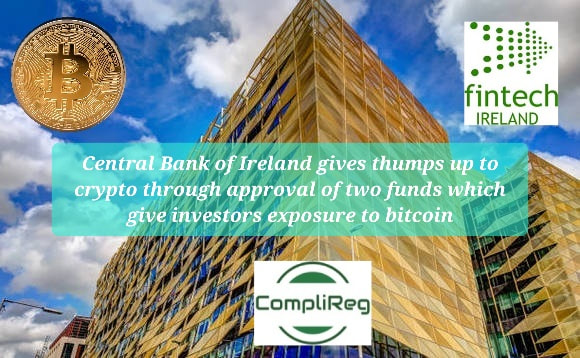
The first Irish regulated funds to take exposure to crypto-assets have been approved by the Central Bank of Ireland (CBI).

The funds, both Qualifying Investor AIFs (QIAIF), will obtain indirect exposure to Bitcoin, by acquiring cash-settled Bitcoin Futures traded on the Chicago Mercantile Exchange (CME). Before you get too excited looking to by some of the digital asset via the QIAIFs note that this channel of exposure is RESTRICTED TO PROFESSIONAL INVESTORS. [NB: As recently as March 2022 the the Central Bank has issued a warning on the risks of investing in crypto assets].  We have provided further details about the regulatory crypto investing landscape in Ireland under 'Further Reading' below.
 
Last month the CBI informed industry bodies that it had approved in principle at least one QIAIF with a low level of exposure to cash settled Bitcoin futures traded on the CME.
 
The two unnamed QIAIFs are the first type of such funds to provide indirect crypto exposure and approved by the CBI.
 
If you want your existing QIAIFs or you wish to establish a new QIAIF to obtain exposure to crypto assets, get in touch (details above).  I am asked on a regular basis by institutional investors and professional investors how they can get exposure to cryptocurrencies and other digitalassets via regulated products. Unless you are able to gain direct exposure via a virtual asset service provider (VASP), the Irish QIAIF model (non-UCITS) might be your avenue. Note however that the CBI has said it is highly unlikely to approve a UCITS proposing any exposure (either direct or indirect) to crypto assets. Thus retail investors wanting crypto exposure in Ireland need to turn to VASPs/Exchanges direct.

Through Fintech Ireland, CompliReg and the industry experts network, we know the lawyers, ManCos and depositories / custodians who can assist institutional/professional firms and funds promoters looking to gain exposure to the crypto markets.  Further, if you are seeking a registration as a virtual service asset provider or authorisation as a MiFID, emoney institution or payments institution to provide services to  institutional, professional and retail clients, check out our Authorisation Page.


Further reading:
  • ID1145 - Central Bank of Ireland 44th Edition (20 December 2021) of the Central Bank AIFMD Q&A

​Question. Can a RIAIF or a QIAIF invest either directly or indirectly in crypto-assets?

Answer. Crypto-assets are generally considered to be private digital assets that depend primarily on cryptography and distributed ledger or similar technology. However, the nature and characteristics of crypto-assets vary considerably. For example, crypto-assets that are tokenised traditional assets (whose value is linked to an underlying traditional asset or a pool of traditional assets (such as financial instruments or commodities)) may have a different risk profile when compared to other crypto-assets that are based on an intangible or non-traditional underlying. For the purposes of this Q&A “crypto-asset” is used to refer to the latter type of crypto-asset. The Central Bank must be satisfied that direct or indirect exposure to crypto-assets is capable of being appropriately risk managed. As of the date of publication of this Q&A, the Central Bank has not seen information which would satisfy it that direct or indirect exposure to crypto-assets is capable of being appropriately risk managed. Though crypto-assets do not all have uniform characteristics, the Central Bank has noted that they can present significant risks, including liquidity risk; credit risk; market risk; operational risk (including fraud and cyber risks); money laundering / terrorist financing risk; and legal and reputation risks. Taking into account the specific risks attached to crypto-assets and the potential that retail investors will not be able to appropriately assess the risks of making an investment in a fund which gives such exposures, the Central Bank is highly unlikely to approve a RIAIF proposing any exposure (either direct or indirect) to crypto assets. In the case of a QIAIF seeking to gain exposure to crypto-assets, the relevant QIAIF would need to make a submission to the Central Bank outlining how the risks associated with such exposures could be managed effectively by the AIFM. The Central Bank’s approach in relation to crypto-assets will be kept under review, continue to be informed by European regulatory discussions on the topic and may change should new information or developments emerge in the future
. 
​

  • ​​ID 1100  - Central Bank of Ireland 36th edition (20 December 2021) of the Central Bank UCITS Q&A

​Question.  Can a UCITS invest either directly or indirectly in crypto-assets?

Answer. Crypto-assets are generally considered to be private digital assets that depend primarily on cryptography and distributed ledger or similar technology. However, the nature and characteristics of crypto-assets vary considerably. For example, crypto-assets that are tokenised traditional assets (whose value is linked to an underlying traditional asset or a pool of traditional assets (such as financial instruments or commodities)) may have a different risk profile when compared to other crypto-assets that are based on an intangible or non-traditional underlying. For the purposes of this Q&A “crypto-asset” is used to refer to the latter type of crypto-asset. The Central Bank must be satisfied that assets in which a UCITS invests are capable of meeting the eligible asset criteria for UCITS and that indirect exposure to the assets is capable of being appropriately risk managed. As of the date of publication of this Q&A, the Central Bank has not seen information which would satisfy it that crypto-assets are capable of meeting the eligible asset criteria for UCITS or that indirect exposure to crypto-assets is capable of being appropriately risk managed. Though crypto-assets do not all have uniform characteristics, the Central Bank has noted that they can present significant risks, including liquidity risk; credit risk; market risk; operational risk (including fraud and cyber risks); money laundering / terrorist financing risk; and legal and reputation risks. Taking into account the specific risks attached to crypto-assets and the potential that retail investors will not be able to appropriately assess the risks of making an investment in a fund which gives such exposures, the Central Bank is highly unlikely to approve a UCITS proposing any exposure (either direct or indirect) to crypto assets. The Central Bank’s approach in relation to crypto-assets will be kept under review, continue to be informed by European regulatory discussions on the topic and may change should new information or developments emerge in the future. 


  • Central Bank of Ireland Warning (22 March 2022)
The Central Bank again emphasised that crypto assets are highly risky and speculative, and may not be suitable for retail customers. In particular people need to be alert to the risks of misleading advertisements, particularly on social media, where influencers are being paid to advertise crypto assets.  The Central Bank has published a plain English explainer for consumers on cryptocurrencies.

  • European Supervisory Authorities (EBA, ESMA and EIOPA Warning (17 March 2022)
The ESAs warned consumers that many crypto-assets are highly risky and speculative. The ESAs set out key steps consumers can take to ensure they make informed decisions.
0 Comments
<<Previous
Forward>>

    Author

    Fintech Ireland

    Archives

    December 2026
    June 2026
    May 2026
    March 2026
    December 2025
    October 2025
    September 2025
    July 2025
    March 2025
    February 2025
    January 2025
    December 2024
    November 2024
    October 2024
    July 2024
    June 2024
    May 2024
    April 2024
    March 2024
    February 2024
    December 2023
    November 2023
    October 2023
    September 2023
    August 2023
    July 2023
    June 2023
    May 2023
    April 2023
    February 2023
    October 2022
    July 2022
    June 2022
    April 2022
    March 2022
    January 2022
    December 2021
    July 2021
    May 2021
    April 2021
    March 2021
    February 2021
    January 2021
    November 2020
    October 2020
    September 2020
    August 2020
    July 2020
    April 2020
    February 2020
    July 2019
    April 2019
    March 2019
    February 2019
    January 2019
    October 2018
    September 2018
    July 2018
    June 2018
    May 2018
    April 2018
    March 2018
    January 2018
    October 2017
    September 2017
    August 2017
    July 2017
    June 2017
    May 2017
    March 2017
    January 2017
    December 2016
    November 2016
    September 2016
    August 2016
    July 2016
    June 2016
    May 2016
    April 2016
    March 2016
    February 2016
    December 2015
    September 2015
    July 2015
    June 2015
    May 2015
    April 2015
    March 2015
    September 2014
    January 2014

    Categories

    All
    Account Information Services
    AISP
    Anne Boden
    Authorisations
    #bankinginquiry
    Bank Of England
    Bitcoin
    Brian Fahey
    British Embassy Dublin
    Business Post
    CB Insights
    Central Bank Of Ireland
    Challenger Bank
    Chambers And Partners
    Competition And Consumer Protection Commission
    Compliance
    Consultations
    Contributor Articles
    Corporate Governance
    Crowdingfunding
    Crypto Assets
    Cryptocurrencies
    Currency Fair
    Cyber Security
    DeFi
    Department Of Finance
    Digital Assets
    Digital Euro
    Digital Wallets
    Directors Duties
    Disruption
    Dogpatch Labs
    Electronic Money
    EML Payments
    EMoney
    European Commission
    Financial Literacy
    Fintech
    Fintech Abu Dhabi
    Fintech Hub
    Fintech Ireland
    Fintech Ireland Map
    Fintech Ireland Summit
    Fintech Leaders Series
    Funding
    Funds
    Gemini
    Ifs2020
    Ifsc
    Innovation
    International Financial Services Strategy
    Ireland For Finance
    Irish Fintech Companies
    John Berrigan
    Kraken
    Mairead McGuiness
    Marketplace
    MiCA
    Mifid
    Moneycorp
    Money Laundering
    Monzo Bank
    MoonPay
    MyComplianceOffice
    Neobanks
    Newsletter
    Nuapay
    @oakeslaw
    OFX Payments
    Paschal Donohue
    Payments
    Payments Institution
    Paysafe
    Payward
    Peer To Peer
    Peer-to-peer
    Realex Payments
    Regtech
    Regulated Fintech
    Regulation
    Roboadvisers
    Robo Advisors
    Robo-advisors
    Ronan Gallagher
    RTE
    Sandbox
    Sentenial
    Simon Harris
    Square
    SquareUp International
    Stablecoins
    Starling Bank
    Strategy
    SYNC Payments
    The Project Foundry
    TransferMate
    Unicorn
    Unicorns
    USA Today
    Virtual Assets
    Wealthtech
    Zodia Custody
    Zodia Markets

©Fintech Ireland and ©Fintech.  Fintech Ireland (523657) and Fintech (523656) are registered with the Companies Registration Office in Ireland
www.fintechireland.com / www.fintechireland.ie / www.irishfintech.ie / www.irishfintech.com / www.fintechcareers.ie
Privacy Policy