Check http://brexitdublin.com/whos-moving-here.html for latest version
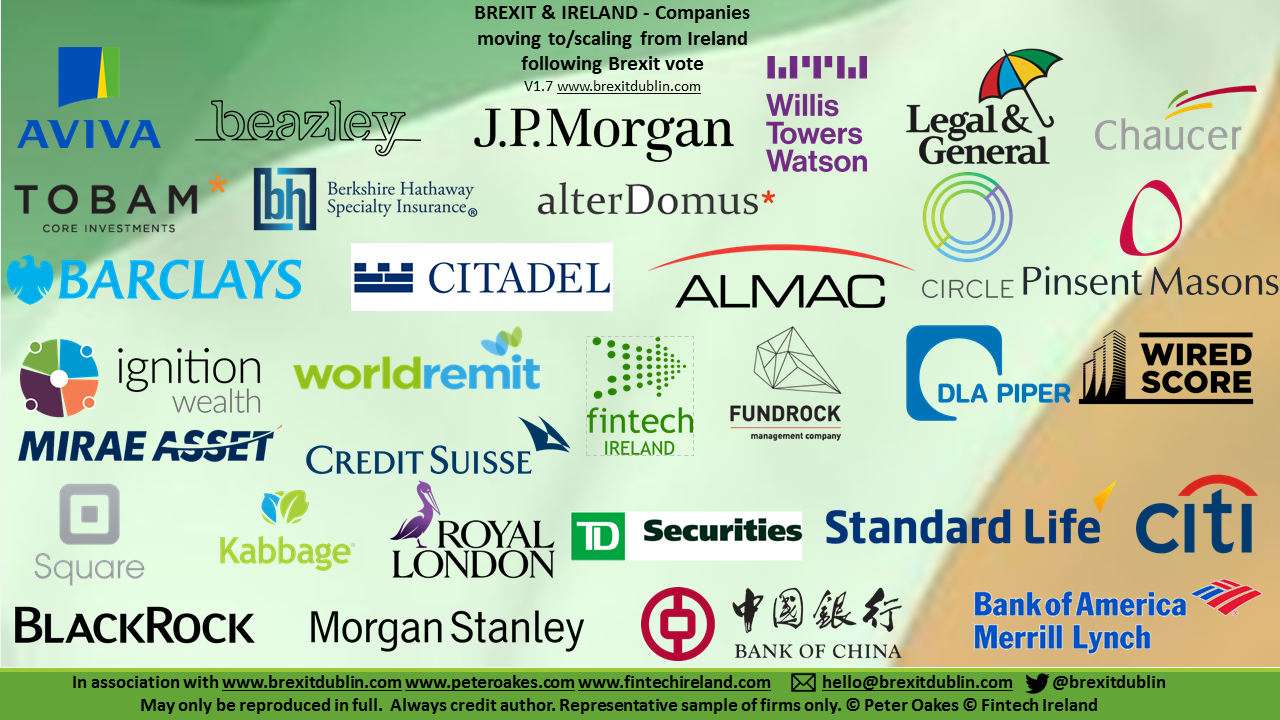
Check http://brexitdublin.com/whos-moving-here.html for latest version New Brexit & Ireland website and service announced to help fintech and finserv establish sustainable presence in Ireland. www.brexitdublin.com also provides links to news reports about international companies relocating to. and scaling from, Ireland.
0 Comments
This post is an introduction to a review of Zopa Lending by Orca Money and Iain Niblock. The contents of this post and links to information within are the sole responsibility of Orca Money. "Zopa, founded in 2005, was the first peer-to-peer lending (P2P) platform to launch in the UK and globally. Zopa allows investors to lend money to consumers seeking personal loans to purchase cars, consolidate debt or to fund home renovations. Zopa has facilitated more personal loans than any other provider and in July 2017 had lent a cumulative £2.44bn, marginally behind Funding Circle’s £2.47bn. Zopa currently boasts 60,000 lenders on its platform, with retail investors representing just over half of their volumes and institutions representing the rest. Zopa’s success in the institutional space has led to key strategic partnerships with the likes of Metro Bank. Investors can choose between Zopa Core or Zopa Plus products, which is a reduction from the three investment product choices offered this time last year. The main difference between the products is the loan-types invested in, which results in differing expected rates of return. Previously, Zopa had three products: Zopa Access, Zopa Classic and Zopa Plus. Zopa Core and Zopa Plus both have a minimum investment amount of £1,000 and offer “auto-bid” functionality, which means that your capital is automatically lent out in chunks starting at £10 to ensure your portfolio is sufficiently diversified. To access your money early, there is a 1% fee applicable on both products. Currently, retail investors are not able to access Zopa’s products due to high demand, but potential investors can sign-up online to be notified once Zopa are accepting capital again. Withdrawing Funds During the loan term, Zopa investors will receive monthly repayments from borrowers. Investors can select whether their account should hold these repayments in their holding account, or whether to have them automatically re-invested in new opportunities (this is the default setting). Investors can withdraw money from their holding account at no extra charge and so if investors wish to withdraw their money at no cost they will have to wait until all repayments have been made. With loan terms up to 60 months on Zopa, it may take up to 60 months to receive all your capital and interest back, if you choose not to re-lend. The headline advertised interest figures assume that you re-lend your money, so if you were to turn this setting off your actual interest rate would reduce. Depending on the length of the remaining loans, it may be better to take the 1% hit and invest the funds elsewhere. To withdraw funds earlier than this, investors must sell their loan parts to other investors on the Zopa secondary market. Zopa charges 1% to sell loans parts on the secondary market. Although it is worth noting that this relies on buyers being willing to buy these loans, which under normal market conditions is highly likely, but of course there may be a circumstance in adverse conditions where this is not the case and you have to wait out the term of your loan. Net Returns To estimate net returns, Orca has conducted loan by loan cashflow analysis on every loan originated by Zopa. An accurate estimation of actual net returns can be made for the years where 100% of loans are complete. As the maximum loan term on the Zopa platform is 5 years, loans as far back as 2012 are still in circulation and therefore at risk of default. As the years progress the percentage of assets (loans) under management increases, and the accuracy of net returns estimates decreases. The chart below assumes that all assets under management complete as planned with all repayments made. No default estimation has been applied. The actual net return will therefore be reduced as loans progress through their term. You can see default rates in the next chart below. Net returns prior to 2014 have consistently been above 5%, even during the 2008 recession. Post 2008, competition for borrowers was low, pushing up the weighted average borrower rates, even for prime borrowers." Continue reading this post on Orca Money's webiste at https://www.orcamoney.com/blog/zopa-lending Click here for the Discussion Paper Deadline to respond: 6 November 2017 The European Banking Authority (EBA) published today a Discussion Paper on its approach to financial technology (FinTech). The EBA sets out in the Discussion Paper the results of the first EU-wide FinTech mapping exercise and its proposals for future work on FinTech. FinTech has the potential to transform the provision of financial services. For this reason, public authorities in the EU and beyond have started to investigate the impact FinTech is having on the financial system and its regulation and supervision. The EBA has conducted already a significant amount of work in relation to certain types of financial innovations, such as crowdfunding and virtual currencies, but is stepping up its FinTech-related work to investigate the impact of FinTech on the financial system and its regulation and supervision. To gain a better understanding of current FinTech activity in the EU, in spring 2017, the EBA launched the first EU-wide FinTech mapping exercise to which it received responses from 22 Member States and 2 EEA States. Detailed information was provided for 282 FinTech firms. Based on the FinTech mapping exercise and existing EBA work, the EBA has identified proposals for future work in six areas: (i) authorisation and sandboxing regimes; (ii) the impact on prudential and operational risks for credit institutions, electronic money institutions and payment institutions; (iii) the impact of FinTech on the business models of these institutions; (iv) consumer protection and retail conduct of business issues; (v) the impact of FinTech on the resolution of financial firms; and (vi) the impact of FinTech on anti-money laundering and countering the financing of terrorism. The EBA invites views from stakeholders on the scope of its proposed work.Consultation processComments to this consultation can be sent to the EBA by clicking on the "send your comments" button on the consultation page. Please note that the deadline for the submission of comments is 06 November 2017. A public hearing will take place at the EBA premises on 4 October 2017 from 14:00 to 16:00 UK time. All contributions received will be published following the end of the consultation, unless requested otherwise.Legal basisThe EBA Founding Regulation mandates the EBA to act in the field of activities of credit institutions, financial conglomerates, investment firms, payment institutions, and electronic money institutions. The EBA is tasked with monitoring new and existing financial activities, and market developments in the areas of its competence, and may adopt guidelines and recommendations or provide advice to the European Parliament, the Council and the Commission, with a view to promoting the safety and soundness of markets and convergence of regulatory and supervisory practices and to achieving a coordinated approach to the regulatory and supervisory treatment of new or innovative financial activities. In this context, the EBA has published the Discussion Paper with a view to seeking views on its proposed future work in relation to FinTech. Presentations from FinCoNet Seminar 7 April 2017 - Fintech, Regtech and Consumer Protection25/7/2017 Peter Oakes, Founder of Fintech Ireland gave a presentation as part of the Session 1 Panel. His slides are here.
Back on 7th April 2017 at the Central Bank of Ireland's new premises, FinCoNet gathered for a seminar to allow supervisors and other parties interested in financial consumer protection to listen to, exchange views with, and pose questions to a variety of speakers over three panels on topics related to financial innovation and consumer protection. The FinCoNet Open Meeting provided an opportunity for supervisors to discuss these topics further, to learn about the work of FinCoNet and to gain useful insights on the benefits of membership through the value of sharing information and knowledge on supervisory tools and best practices. Both the Seminar and Open Meeting will focus on issues relating to fintech and financial consumer protection. Read more about the event here. |
AuthorFintech Ireland Archives
December 2026
Categories
All
|