fintech IRELAND
email / social
  • Home
  • Fintech Authorisations
  • Fintech Education & Training
  • Fintech Ireland Map
    • Fintech Survey
  • Events
    • Summit
    • Events-Archive
  • Fintech Hub
  • News-Insights
    • Consultations
    • News Page Back Up
  • Careers
  • RegTech
  • CRYPTO
  • Fundraising
  • Brexit & Ireland
  • About
    • Fintech Family Network
  • Get Involved

Top 10 regulatory failures by banks across the globe cost them$150 billion between 2009-2015 reveals new research by Corlytics

15/4/2016

0 Comments

 
Picture
Peter Oakes of Fintech Ireland. a leading fintech and regtech expert, looks at the recent work of Irish regtech startup Corlytics

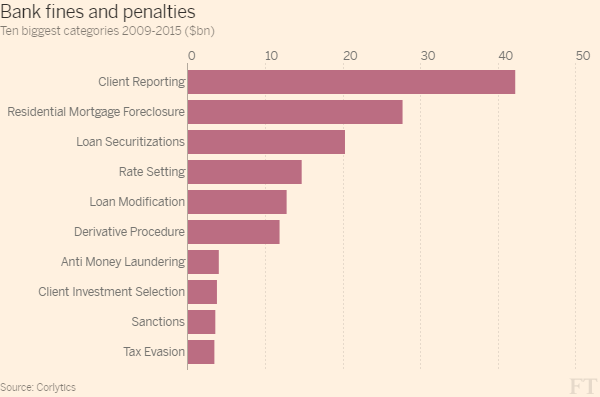
A few weeks ago The Financial Times reported that failures in customer reporting have cost the world’s top investment banks $43bn in fines over the past seven years.  This was the single most expensive compliance issue, according to research undertaken by Irish regtech start-up Corlytics.  Corlytics research also found that the main types of failure and wrongdoing resulted in fines totalling $150bn for 10 US and European banks between 2009 and 2015.  Corlytics is, as the name suggests, an analytics firm. 

In addition to the customer reporting compliance failures, other issue that caused significant financial and regulatory issues for large banks included rigging foreign exchange rates, money laundering to product mis-selling to name just a few.

"The seven years of fines have taken a heavy toll on the banks, wiping out the equivalent of a staggering 14 per cent of their equity capital."

The pool of banks covered by Corlytics’ work are Barclays, Bank of America, Citigroup, Credit Suisse, Deutsche Bank, Goldman Sachs, HSBC, JPMorgan, Morgan Stanley and UBS. The seven years of fines have taken a heavy toll on the banks, wiping out the equivalent of a staggering 14 per cent of their equity capital.  

John Byrne, chief executive of Corlytics, said client reporting failures were the source of substantial fines for banks in a wide variety of cases, including misleading customers about investments and not communicating clearly enough with borrowers. “It can involve any aspect of client disadvantage or loss due to inaccurate or misleading reports or communication,”.
Picture
Corlytics’ work shows poor disclosure to clients was a factor in the $25bn of fines paid by US banks in a 2012 settlement for abusive foreclosure practices. The second most expensive issue for the 10 banks was failures in how they sold residential mortgage securities, which resulted in a penalties total of $27.7bn.  The banks meanwhile paid $20.2bn in fines in relation to securitisation failures. “Rate setting” fines came to $14.6bn, partly stemming from banks’ manipulation of foreign exchange and interest rates.

Mr Byrne said that while many banks have “experienced serious issues with regulators, some have not”.
“The data seems to indicate that the less diversified a bank, the lower the regulatory risk,” he added. “This may be because with fewer business lines, [internal] controls can be better understood and implemented.”
The high point for penalties was 2014, when banks paid $56.2bn in fines for compliance issues ranging from foreign exchange and interest rate rigging to flaws in selling mortgage securities. Banks paid fines of $40.2bn in 2013, and $38.2bn in 2012.

Banks’ penalties came to just under $10bn in 2015. However, European banks are braced for substantial fines this year when they find out how much they will pay for mis-selling mortgage bonds.

The fines do not cover most of the £30bn that UK banks paid for mis-selling payment protection insurance. This is because Barclays and HSBC are the only two British companies that rank among the world’s top 10 investment banks, and therefore are included in Corlytics’ work.

Corlytics has assembled a database about banks’ penalties based on disclosures by authorities with powers to levy fines.

The Dublin-based company sells the database to banks looking to pinpoint areas of weakness, and regulators which want to know how their penalties compare to others.
0 Comments

€50k funding now available for international entrepreneurs

3/4/2016

0 Comments

 
Picture
€50k funding now available for international entrepreneurs

Early-stage companies in manufacturing and the internationally-traded services sector from around the globe are being invited to consider doing business in Ireland. Enterprise Ireland has launched a competitive fund aimed at supporting worldwide start-ups and entrepreneurs who are willing to relocate to Ireland.

Under the terms of the Competitive Start Fund (CSF), successful candidates will receive €50,000 in cash to support their business development. Interested applicants have until 3pm, GMT, Wednesday 6 April to express their interest and submit an application.

Shortlisted projects will be invited to travel to Ireland to pitch to the evaluation panel on Wednesday 1 June. Travel costs, up to a maximum of €1,000 per applicant, will be covered by Enterprise Ireland. Candidates successfully awarded the funding will be required to move to Ireland, however Enterprise Ireland will also offer assistance to entrepreneurs who need a visa to live and work here.

Qualifying sectors include: manufacturing and internationally-traded services, such as the following subsectors: Internet, Games, Apps, Mobile, SaaS, Cloud Computing, Enterprise Software, Lifesciences, Fintech, Food, Cleantech and Industrial Products.

The maximum support available is €50,000 for a 10% ordinary equity stake in the start-up company. This investment shall be released in two equal tranches, the first of which will be released to successful applicants only when they provide confirmation of additional new cash investment for equity of €5,000. This new investment in equity of €5,000 by the successful applicant is to occur after the relevant call close date.
 
If you what to know more get in touch with us at [email protected] before close of business on 4th April if you wish us to assist with your application. Please put "€50k funding now available for international entrepreneurs" into the header of your email.  Alternatively you can approach Enterprise Ireland direct at www.enterprise-ireland.com before the closing date.

0 Comments

Innovative Finance ISA: how it will affect ‘marketplace lending’, Jordan Stodart, Co-Founder/CMO, Orca Money 

24/3/2016

0 Comments

 
Picture
‘Marketplace Lending’ defined

Before we delve into the eagerly awaited Innovative Finance ISA coming April 6th it would be worthwhile explaining this term, ‘marketplace lending’.

In 2014 the Economist coined peer-to-peer lending ‘Banking without banks’, despite this sentiment being the vocal outcry of UK peer-to-peer platforms, it no longer rings true. Peer-to-peer lending used to be a two-sided network of lenders and borrowers; direct lending between ‘peers’. In 2015, 1,031 institutional funders were reported to have been involved in financing deals across UK alternative finance platforms. 45% of UK platforms reported institutional activity, compare to 28% in 2014. Nesta shed more light on this trend in their annual report.

Picture
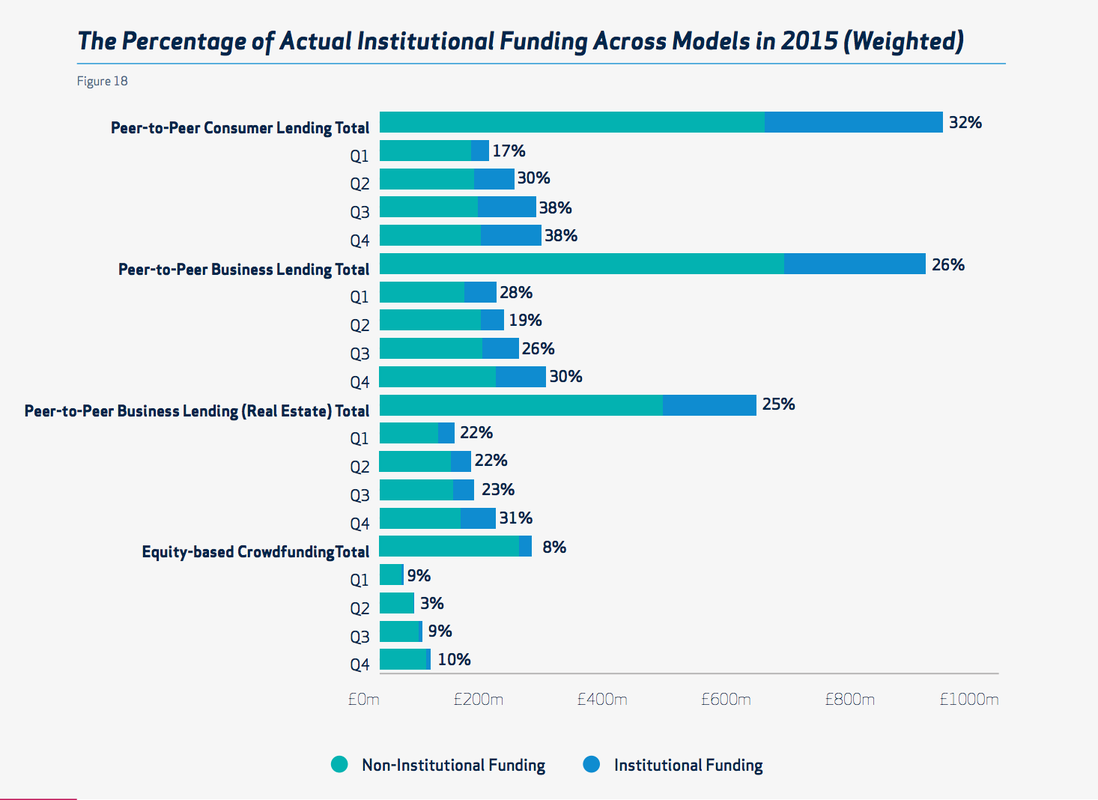
Image 1: Nesta report: 2016

As you can see, this innovative asset class, “peer-to-peer” lending has become entrenched in institutional funding.

·         32% institutional funding P2P consumer lending

·         26% institutional funding P2P business lending (total)

·         25% institutional funding P2P business lending (real estate)

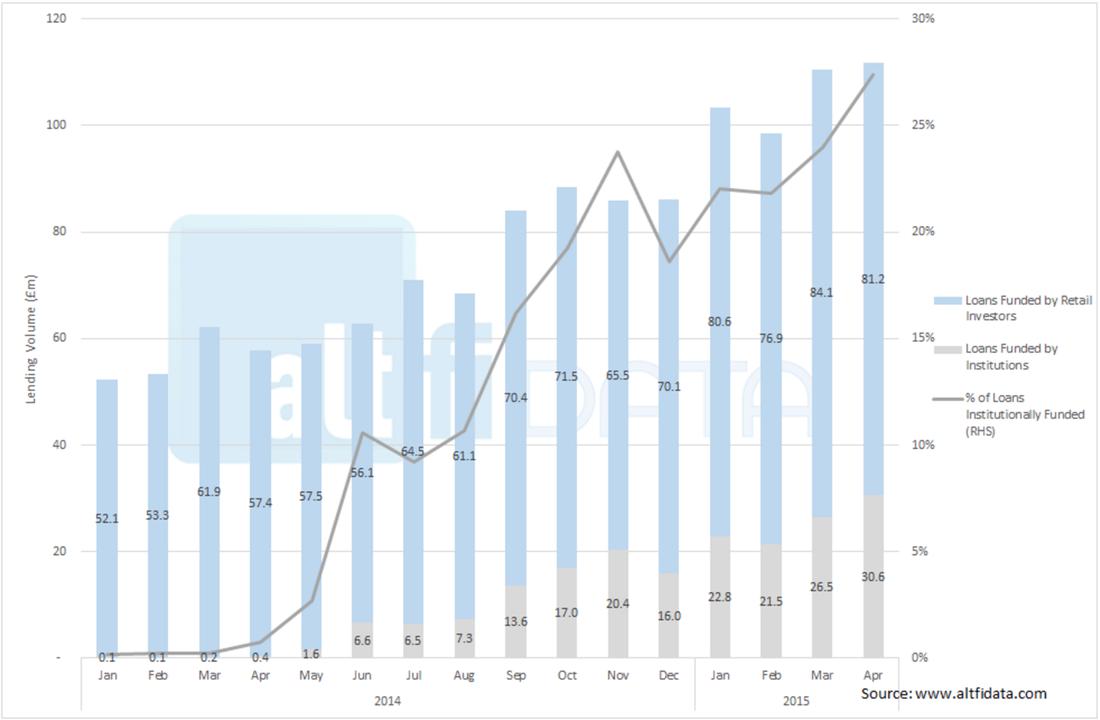
AltFi Data called this in Spring 2015, when they published statistics on institutional funding within the three largest UK platforms: Funding Circle, Zopa and RateSetter.

Picture
Image 2: AltFi Data: estimated aggregate institutional participation in Funding Circle, Zopa and RateSetter originated loans 2014 – April 2015


It is almost one year on, and evidently the darky grey line has continued to rise. What assertions can we draw? Well, as borrower numbers increase, lending institutions can facilitate the loans where retail investors can’t; there aren’t enough of them. With over 10,000 UK SMEs and 600 commercial property developments funded in 2015 (P2P business lending) it is no wonder institutional activity has become an underpinning feature of marketplace lending.

·         It took 490 P2P investors (avg) to fund a typical real estate loan of £522,333 (2015), demonstrating the volumes required to fund an average loan.

Also, the institutional grip on peer-to-peer consumer lending has become even tighter. UK consumer lending in P2P is still considered a retail investor’s game, but it was reported that institutional investment rose significantly towards the close of 2015, having had modest involvement at the beginning of the calendar year.

·         £288m was lent by institutional funders across consumer lending platforms in 2015 accounting for 32% of total market volumes.

More can be found on institutional activity in the Nesta report, page 40 onwards.

To reaffirm institutional funding of peer-to-peer loans, AltFi published stats on Funding Circle, who, by Autumn 2015, were funding whole loans preserved for institutional lenders (not retail investors) at a rate of 50% of total monthly loan volumes (see: July whole loans vs fractional loans graph 1).

Innovative Finance ISA (IFISA) will boost retail investor numbers 

 Now that peer-to-peer lending UK could be conceived as a “thing of the past”, having evolved into marketplace lending, we can assess the impact of the Innovative finance ISA on this now very much institutionally affected market.

The Innovative Finance ISA, or ‘peer-to-peer ISA’ as some are calling it, will allow retail investors, or retail savers to look for an alternative investment, to earn tax-free interest on their annual allowance of £15,240 in 2016. Investors can open an IFISA with a single P2P platform, investing their allowance, or accumulated allowances, to earn higher interest rates than those offered by the other two main ISA products: cash ISA and stocks & shares ISA. There are some complexities to this new ISA, so read ‘Innovative Finance ISA 2016: overview’ for a better understanding of how it works,

Peer-to-peer lending real estate platforms are reportedly lowering their minimum investment with the prospect if the new Innovative Finance ISA. An influx of retail investors will come onto the P2P market looking to ‘increase their exposure to the UK property market, not only owning their home, but also in other ways, such as investing through peer-to-peer lenders’ according to Guglielmo de Stefano of AltFi.

·         Real estate peer-to-peer platforms expect the IFISA to boost the market volume in 2016 by 51%. (Nesta report)

An influx of 405,000 new retail investors is expected this year in light of the introduction of the IFISA. Of 1,020 UK adults surveyed, 19% exclaimed they would open an ISA and start actively saving. An important thing to remember is that P2P lending is an alternative investment product, and not a savings product. Retail investors, savers, whatever they deem themselves, will not be covered by the FSCS if funds are lost.

To conclude, peer-to-peer lending has evolved into marketplace lending with institutional investing permeating the industry. The Innovative Finance ISA will stimulate retail savers and investors alike boosting the marketplace lending industry. With more retail investors coming onto the market what affect will this have on the dichotomy of institutional lenders and retail investors? 2016 will be a testing year for marketplace lending, and with only Zopa and RateSetter marketing their peer-to-peer ISA products how much of an impact will the Innovative Finance ISA actually have. 

Jordan is a FinTech enthusiast and co-founder of UK’s no.1 peer-to-peer lending comparison service, where the everyday person can research, compare and feel empowered to invest and earn more money on their money. [email protected], @orca_money, www.orcamoney.com 
0 Comments

Digital Reinvention: Fintech & The Future of Banking, Tommy Kearns CEO, XtremePush, Co-founder Imobile

22/3/2016

0 Comments

 
Picture
I recently met with Tommy Kearns (CEO) and Kevin Collins (CTO), the co-founders of XtremePush in their Dublin office.  Some very interesting things happening in their space.  Tommy has kindly provided this article for Fintech Ireland.

The traditional business model of banking is being turned on its head with the advent of mobile-first technologies, the growing impact of blockchain and the challenge of connecting with a new generation of banking customers with a ‘show-me-you-know-me’ outlook to brand interaction.

By 2025, Millennials will hold 75% of the global workforce. Closely behind them are Gen Z, born in the early 2000s onwards, these digital natives never lived without the Internet or mobile technology. They expect instant information and gratification, 24-hour service and frictionless mobile experiences. When it comes to banking, both groups desire personalised online services and they place a lot less value on cash-based transactions than the generations before them.

According to the 2015 TD Bank Checking Experience Index, an annual survey of 1,500 Americans conducted by TB Bank, nearly three-quarters (74%) of Gen Z’s budding financial consumers describe their debit card as “essential” and 41% view their bank’s mobile app as non-negotiable in their daily lives.

With these trends in mind, we are increasingly looking at the possibility of a cashless society in the near future. Will bank branches become a thing of the past, for example?

New FinTech providers, such as Uphold, and other cloud money platforms that deal exclusively with the internet of money, signal the rise of connected commerce. Everyday devices such as appliances, wearables and cars can now connect to the Internet thanks to tiny sensors embedded inside. More and more of these smart devices will have cutting-edge digital payment capabilities that allow them to initiate payments on consumers’ behalf, when contextually relevant.

Almost every type of financial activity – from retail banking to wealth management - is being reimagined digitally by financial service innovators to meet changing consumer demands.

Within the next 5 years, we will witness the emergence of more FinTech companies who have full banking licensing and who will buy or build physical distribution to complement their existing customer offering. The European Payment Services Directive (PSD2) is also set to further open the payment market in Europe to these new services and players, known as ‘Payment Initiation Service Providers (PISPs), by providing them with an official legal framework in which to operate. This will enable consumers to onboard and offboard money at ease. So where exactly will the traditional financial institutions fit in?

The banking giants will still provide the very valuable infrastructure and liquidity required to power the financial services industry. But what we are going to see more and more are banks who have hugely innovative services and applications running in conjunction with their existing infrastructure. They will enter into strategic partnerships with FinTech start-ups to introduce new innovative services and technology that will help them to maintain and boost their competitive advantage. And they may even eventually decide to invest in or acquire some of these companies who share their data-driven, customer-centric vision and who bring significant value to the bank’s end-customers.

A case in point: Spanish financial services provider BBVA purchased a 30% stake in Atom Bank, a UK online-only consumer bank, in November 2015. Since then, they have also acquired Holvi, a Dutch online-only bank specifically for entrepreneurs and SMEs.

As financial institutions go on this radical journey of digital reinvention, enterprise-grade FinTech service providers will provide the vital elements banks need to build deeper relationships with their customers, create new revenue streams and bridge the technology gap that separates them from the new breed of financial service challengers.

Further information for Tommy Kearns:
Email: [email protected]
Website: www.xtremepush.com
LinkedIN: https://www.linkedin.com/in/tommykearns


0 Comments

Mogo – “Building the leading digital financial brand in Canada that empowers consumers with simple financial solutions”.  Interview with Steven Kerr, Vice President, Credit Risk & Collections. 

18/3/2016

0 Comments

 
Picture
“Up to 60% of banks’ retail profits could be lost by 2025 to nimble fintech firms”  according to the recent McKinsey 2015 Annual Review of Global Banking.

We caught up with Steven Kerr, Vice President, Credit Risk & Collections at Mogo Financial Technology Inc., a Canadian listed fintech firm, that not only is one of Canada's fastest growing financial technology companies, it was also recently selected as a finalist for the International FinTech Innovation Awards 2016 in the FinTech Marketing Category. Mogo has been recognized for its groundbreaking, national, millennials-and-money event series "Adulting 101". 

Steven is from Belfast, previously worked in Dublin with GE Money and moved to Vancouver in 2011. He has worked at Mogo for the last 3 years.

Fintech Ireland: What is Mogo all about?

Mogo: We are building a digital financial brand for the next generation of Canadians by offering convenience, transparency, and products that are designed to help consumers manage and stay in control of their financial health. We have over 180,000 members and we are growing fast, we’re using technology and design to build a digital experience that makes it easier for consumers to make smarter decisions about their money.

Fintech Ireland:  What makes you different from traditional banks?

Mogo: Unlike a bank, consumers can open a free MogoAccount 24/7 in about 3 minutes, whether it be at home on their computer, laptop or more likely on the go through their smartphones. This gives customers access to all of Mogo’s unique financial tools and content including their free credit score which is an important part of managing your financial health.

Fintech Ireland: We are seeing more and more companies saying that they are disrupting this banking space.  What are the strategic advantages for a business like Mogo versus banks?

Mogo:  This is all about disruption. The key strategic advantages of a fintech business like Mogo are:                                    

FINTECH

Modern technology platform

Low fees & transparency 

 Millennial brand

Low-cost digital model 

Agile culture  


vs

vs

vs

vs

vs
BANKS

 Legacy technology

High & hidden fees

Legacy brand

High-cost branch model

Old-school approach
Fintech Ireland:  So what products do you offer, are you a deposit taking institution?

Mogo: No we are not a deposit taking institution.  As we like to say, we are not a bank by design.  However, we are looking to offer many of the same products that banks offer and will partner with banks where needed.  For instance, our new Platinum Prepaid Visa card, which is a smart mobile-first alternative to a chequing account, is tied to a mobile app, giving members responsive data to help them stay in control of their spending while avoiding overspending and fees.  For this product we have partnered with an issuing bank in Canada for some of the back-end servicing.   Importantly, we are focused on leveraging our technology platform to deliver a digital experience as well as our innovative product design and brand experience.  

We see Mogo’s products as a key part of a consumer’s financial wallet. In the 3 minutes it takes to open a MogoAccount, a member gains access to the full suite of Mogo benefits and products. MogoMoney has a full spectrum line of personal loans that can help a customer get out of debt sooner by rewarding good payments with even lower rates over time. This is part of Mogo’s innovative Level Up program and an example of our commitment to socially responsible finances.  The company is also focused on expanding beyond consumer lending and offering services such as the MogoMortgage.


Fintech Ireland:  Are you an alternative banking service or a technology firm?

Mogo: We are essentially leveraging our technology, innovative product design and unique brand to transform the way the next generation of consumers access and use financial products.  First and foremost it is about the digital financial platform here at Mogo that provides us some key advantages over a traditional bank, including; the flexibility to launch multiple new product lines all supported by our big data warehouse, next-gen decisioning platform and agile credit strategy that allows us to develop models and bring them to market at a speed the banks just can’t compete with. 

Fintech Ireland:  Give us an overview on the credit department at Mogo.

Mogo: Here at Mogo I would say that we have an obsessive approach to credit that borders on OCD! We have a great foundation based on our platform that combines a big data warehouse with latest machine learning software and a data science department focused on model development using both traditional and non-traditional data sources. We have a proven credit discipline given the funding for our loans comes from Fortress Investment Group, so despite extremely high growth we have managed the credit portfolio in line with strict performance benchmarks. This has produced an amazing level of granularity in portfolio management that supports the constant optimization of our credit strategies.

Fintech Ireland:  Tell us about the recent partnership you entered into with PostMedia?

Mogo: We couldn’t be more excited about this innovative partnership that we’ve struck with PostMedia. One of the biggest challenges for a company looking to disrupt the financial space is brand awareness and the cost it takes to acquire new members. With a minimum commitment of $50M in marketing spend over the next 3 years we now have access to PostMedia’s 200+ trusted brands, including most of the major local and national papers in Canada (both digital and print).  This gives us access to approx. 76% of English speaking Canadian adults which clearly moves us a lot closer to our goal of becoming the leading digital financial brand in Canada.

To learn more visit www.mogo.ca or follow us on Twitter https://twitter.com/mogomoney

At Fintech Ireland we are always on the look out for great fintech stories like this one about Mogo.  If you would like to get in touch to discuss something similar or contributing a post or commentary, please contact us at [email protected] 
0 Comments
<<Previous
Forward>>

    Author

    Fintech Ireland

    Archives

    December 2026
    June 2026
    May 2026
    March 2026
    December 2025
    October 2025
    September 2025
    July 2025
    March 2025
    February 2025
    January 2025
    December 2024
    November 2024
    October 2024
    July 2024
    June 2024
    May 2024
    April 2024
    March 2024
    February 2024
    December 2023
    November 2023
    October 2023
    September 2023
    August 2023
    July 2023
    June 2023
    May 2023
    April 2023
    February 2023
    October 2022
    July 2022
    June 2022
    April 2022
    March 2022
    January 2022
    December 2021
    July 2021
    May 2021
    April 2021
    March 2021
    February 2021
    January 2021
    November 2020
    October 2020
    September 2020
    August 2020
    July 2020
    April 2020
    February 2020
    July 2019
    April 2019
    March 2019
    February 2019
    January 2019
    October 2018
    September 2018
    July 2018
    June 2018
    May 2018
    April 2018
    March 2018
    January 2018
    October 2017
    September 2017
    August 2017
    July 2017
    June 2017
    May 2017
    March 2017
    January 2017
    December 2016
    November 2016
    September 2016
    August 2016
    July 2016
    June 2016
    May 2016
    April 2016
    March 2016
    February 2016
    December 2015
    September 2015
    July 2015
    June 2015
    May 2015
    April 2015
    March 2015
    September 2014
    January 2014

    Categories

    All
    Account Information Services
    AISP
    Anne Boden
    Authorisations
    #bankinginquiry
    Bank Of England
    Bitcoin
    Brian Fahey
    British Embassy Dublin
    Business Post
    CB Insights
    Central Bank Of Ireland
    Challenger Bank
    Chambers And Partners
    Competition And Consumer Protection Commission
    Compliance
    Consultations
    Contributor Articles
    Corporate Governance
    Crowdingfunding
    Crypto Assets
    Cryptocurrencies
    Currency Fair
    Cyber Security
    DeFi
    Department Of Finance
    Digital Assets
    Digital Euro
    Digital Wallets
    Directors Duties
    Disruption
    Dogpatch Labs
    Electronic Money
    EML Payments
    EMoney
    European Commission
    Financial Literacy
    Fintech
    Fintech Abu Dhabi
    Fintech Hub
    Fintech Ireland
    Fintech Ireland Map
    Fintech Ireland Summit
    Fintech Leaders Series
    Funding
    Funds
    Gemini
    Ifs2020
    Ifsc
    Innovation
    International Financial Services Strategy
    Ireland For Finance
    Irish Fintech Companies
    John Berrigan
    Kraken
    Mairead McGuiness
    Marketplace
    MiCA
    Mifid
    Moneycorp
    Money Laundering
    Monzo Bank
    MoonPay
    MyComplianceOffice
    Neobanks
    Newsletter
    Nuapay
    @oakeslaw
    OFX Payments
    Paschal Donohue
    Payments
    Payments Institution
    Paysafe
    Payward
    Peer To Peer
    Peer-to-peer
    Realex Payments
    Regtech
    Regulated Fintech
    Regulation
    Roboadvisers
    Robo Advisors
    Robo-advisors
    Ronan Gallagher
    RTE
    Sandbox
    Sentenial
    Simon Harris
    Square
    SquareUp International
    Stablecoins
    Starling Bank
    Strategy
    SYNC Payments
    The Project Foundry
    TransferMate
    Unicorn
    Unicorns
    USA Today
    Virtual Assets
    Wealthtech
    Zodia Custody
    Zodia Markets

©Fintech Ireland and ©Fintech.  Fintech Ireland (523657) and Fintech (523656) are registered with the Companies Registration Office in Ireland
www.fintechireland.com / www.fintechireland.ie / www.irishfintech.ie / www.irishfintech.com / www.fintechcareers.ie
Privacy Policy